


Get Special Discount Offer on 350-701 Dumps PDF [UPDATED May-2023]
PDF Download Cisco Test To Gain Brilliante Result!
NEW QUESTION 262
Drag and drop the descriptions from the left onto the correct protocol versions on the right.
Answer:
Explanation: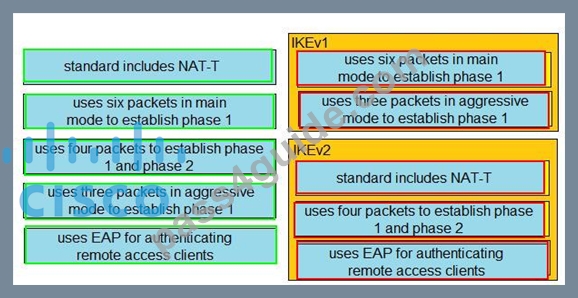
NEW QUESTION 263
Drag and drop the solutions from the left onto the solution's benefits on the right.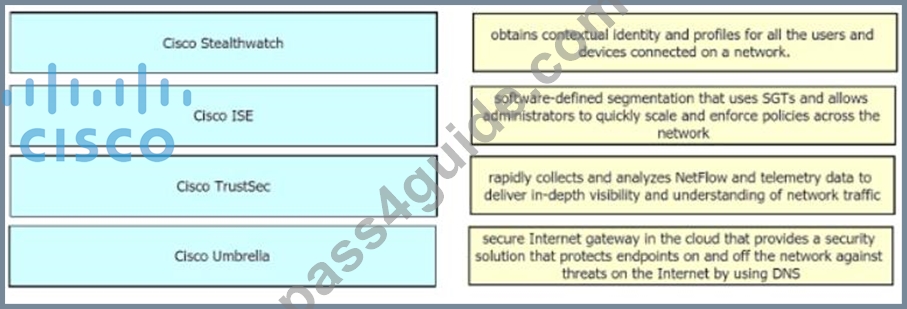
Answer:
Explanation: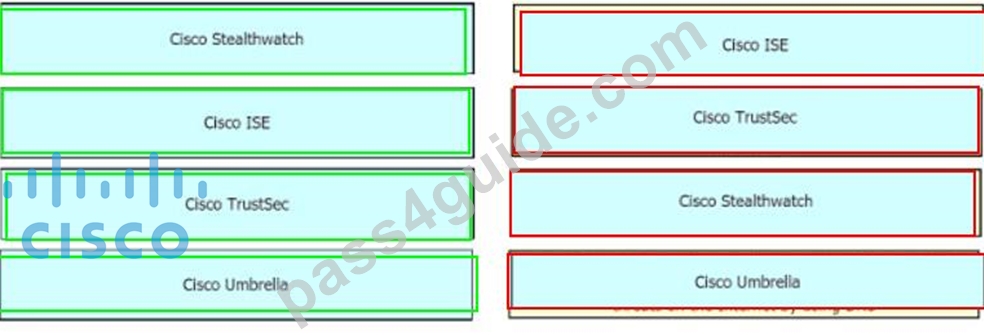
NEW QUESTION 264
What are the two most commonly used authentication factors in multifactor authentication? (Choose two)
- A. knowledge factor
- B. confidentiality factor
- C. biometric factor
- D. encryption factor
- E. time factor
Answer: A,C
Explanation:
Multi-factor Authentication (MFA) is an authentication method that requires the user to provide two or more verification factors to gain access to a resource. MFA requires means of verification that unauthorized users won't have.
Proper multi-factor authentication uses factors from at least two different categories.
MFA methods:
+ Knowledge - usually a password - is the most commonly used tool in MFA solutions. However, despite their simplicity, passwords have become a security problem and slow down productivity.
+ Physical factors - also called possession factors-use tokens, such as a USB dongle or a portable device, that generate a temporary QR (quick response) code. Mobile phones are commonly used, as they have the advantage of being readily available in most situations.
+ Inherent - This category includes biometrics like fingerprint, face, and retina scans. As technology advances, it may also include voice ID or other behavioral inputs like keystroke metrics. Because inherent factors are reliably unique, always present, and secure, this category shows promise.
+ Location-based and time-based - Authentication systems can use GPS coordinates, network parameters, and metadata for the network in use, and device recognition for MFA. Adaptive authentication combines these data points with historical or contextual user data.
A time factor in conjunction with a location factor could detect an attacker attempting to authenticate in Europe when the user was last authenticated in California an hour prior, for example.
+ Time-based one-time password (TOTP) - This is generally used in 2FA but could apply to any MFA method where a second step is introduced dynamically at login upon completing a first step. The wait for a second step-in which temporary passcodes are sent by SMS or email-is usually brief, and the process is easy to use for a wide range of users and devices. This method is currently widely used.
+ Social media - In this case a user grants permission for a website to use their social media username and password for login. This provide an easy login process, and one generally available to all users.
+ Risk-based authentication - Sometimes called adaptive multi-factor authentication, this method combines adaptive authentication and algorithms that calculate risk and observe the context of specific login requests.
The goal of this method is to reduce redundant logins and provide a more user-friendly workflow.
+ Push-based 2FA - Push-based 2FA improves on SMS and TOTP 2FA by adding additional layers of security while improving ease of use. It confirms a user's identity with multiple factors of authentication that other methods cannot. Because push-based 2FA sends notifications through data networks like cellular or Wi-Fi, users must have data access on their mobile devices to use the 2FA functionality.
Reference:
The two most popular authentication factors are knowledge and inherent (including biometrics like fingerprint, face, and retina scans. Biometrics is used commonly in mobile devices).
NEW QUESTION 265
Refer to the exhibit.
Which command was used to generate this output and to show which ports are authenticating with dot1x or mab?
- A. show dot1x all
- B. show authentication registrations
- C. show authentication method
- D. show authentication sessions
Answer: A
NEW QUESTION 266
Which license is required for Cisco Security Intelligence to work on the Cisco Next Generation Intrusion Prevention System?
- A. control
- B. protect
- C. URL filtering
- D. matware
Answer: B
NEW QUESTION 267
Refer to the exhibit.
Which type of authentication is in use?
- A. external user and relay mail authentication
- B. SMTP relay server authentication
- C. POP3 authentication
- D. LDAP authentication for Microsoft Outlook
Answer: A
Explanation:
The TLS connections are recorded in the mail logs, along with other significant actions that are related to messages, such as filter actions, anti-virus and anti-spam verdicts, and delivery attempts. If there is a successful TLS connection, there will be a TLS success entry in the mail logs. Likewise, a failed TLS connection produces a TLS failed entry. If a message does not have an associated TLS entry in the log file, that message was not delivered over a TLS connection. Reference: https://www.cisco.com/c/en/us/support/docs/security/email-security-appliance/118844-technoteesa-00.html The exhibit in this Qshows a successful TLS connection from the remote host (reception) in the mail log.
messages, such as filter actions, anti-virus and anti-spam verdicts, and delivery attempts. If there is a successful TLS connection, there will be a TLS success entry in the mail logs. Likewise, a failed TLS connection produces a TLS failed entry. If a message does not have an associated TLS entry in the log file, that message was not delivered over a TLS connection.
Reference:
The TLS connections are recorded in the mail logs, along with other significant actions that are related to messages, such as filter actions, anti-virus and anti-spam verdicts, and delivery attempts. If there is a successful TLS connection, there will be a TLS success entry in the mail logs. Likewise, a failed TLS connection produces a TLS failed entry. If a message does not have an associated TLS entry in the log file, that message was not delivered over a TLS connection. Reference: https://www.cisco.com/c/en/us/support/docs/security/email-security-appliance/118844-technoteesa-00.html The exhibit in this Qshows a successful TLS connection from the remote host (reception) in the mail log.
NEW QUESTION 268
Drag and drop the descriptions from the left onto the encryption algorithms on the right.
Answer:
Explanation: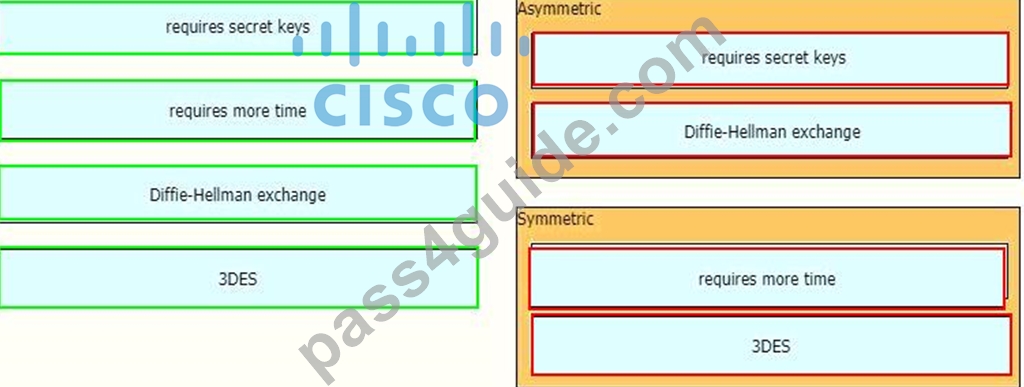
NEW QUESTION 269
What is the role of Cisco Umbrella Roaming when it is installed on an endpoint?
- A. to ensure that assets are secure from malicious links on and off the corporate network
- B. to establish secure VPN connectivity to the corporate network
- C. to enforce posture compliance and mandatory software
- D. to protect the endpoint against malicious file transfers
Answer: A
NEW QUESTION 270
Under which two circumstances is a CoA issued? (Choose two)
- A. A new Identity Service Engine server is added to the deployment with the Administration persona
- B. An endpoint is profiled for the first time.
- C. An endpoint is deleted on the Identity Service Engine server.
- D. A new authentication rule was added to the policy on the Policy Service node.
- E. A new Identity Source Sequence is created and referenced in the authentication policy.
Answer: B,C
Explanation:
The profiling service issues the change of authorization in the following cases:
- Endpoint deleted-When an endpoint is deleted from the Endpoints page and the endpoint is disconnected or removed from the network.
An exception action is configured-If you have an exception action configured per profile that leads to an unusual or an unacceptable event from that endpoint. The profiling service moves the endpoint to the corresponding static profile by issuing a CoA.
- An endpoint is profiled for the first time-When an endpoint is not statically assigned and profiled for the first time; for example, the profile changes from an unknown to a known profile.
+ An endpoint identity group has changed-When an endpoint is added or removed from an endpoint identity group that is used by an authorization policy.
The profiling service issues a CoA when there is any change in an endpoint identity group, and the endpoint identity group is used in the authorization policy for the following:
++ The endpoint identity group changes for endpoints when they are dynamically profiled ++ The endpoint identity group changes when the static assignment flag is set to true for a dynamic endpoint - An endpoint profiling policy has changed and the policy is used in an authorization policy-When an endpoint profiling policy changes, and the policy is included in a logical profile that is used in an authorization policy. The endpoint profiling policy may change due to the profiling policy match or when an endpoint is statically assigned to an endpoint profiling policy, which is associated to a logical profile. In both the cases, the profiling service issues a CoA, only when the endpoint profiling policy is used in an authorization policy. Reference: https://www.cisco.com/c/en/us/td/docs/security/ise/2-1/admin_guide/b_ise_admin_guide_21/ b_ise_admin_guide_20_chapter_010100.html
++ The endpoint identity group changes when the static assignment flag is set to true for a dynamic endpoint - An endpoint profiling policy has changed and the policy is used in an authorization policy-When an endpoint profiling policy changes, and the policy is included in a logical profile that is used in an authorization policy. The endpoint profiling policy may change due to the profiling policy match or when an endpoint is statically assigned to an endpoint profiling policy, which is associated to a logical profile. In both the cases, the profiling service issues a CoA, only when the endpoint profiling policy is used in an authorization policy.
Reference:
++ The endpoint identity group changes for endpoints when they are dynamically profiled ++ The endpoint identity group changes when the static assignment flag is set to true for a dynamic endpoint - An endpoint profiling policy has changed and the policy is used in an authorization policy-When an endpoint profiling policy changes, and the policy is included in a logical profile that is used in an authorization policy. The endpoint profiling policy may change due to the profiling policy match or when an endpoint is statically assigned to an endpoint profiling policy, which is associated to a logical profile. In both the cases, the profiling service issues a CoA, only when the endpoint profiling policy is used in an authorization policy. Reference: https://www.cisco.com/c/en/us/td/docs/security/ise/2-1/admin_guide/b_ise_admin_guide_21/ b_ise_admin_guide_20_chapter_010100.html
NEW QUESTION 271
Drag and drop the posture assessment flow actions from the left into a sequence on the right.
Answer:
Explanation:
NEW QUESTION 272
Refer to the exhibit.
An engineer configured wired 802.1x on the network and is unable to get a laptop to authenticate. Which port configuration is missing?
- A. authentication open
- B. dotlx reauthentication
- C. dot1x pae authenticator
- D. cisp enable
Answer: C
NEW QUESTION 273 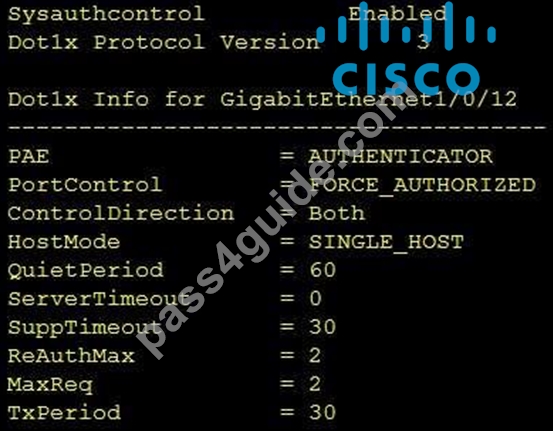
Refer to the exhibit. Which command was used to display this output?
- A. show dot1x all
- B. show dot1x
- C. show dot1x interface gi1/0/12
- D. show dot1x all summary
Answer: A
Explanation:
Explanation/Reference:
Reference: https://www.cisco.com/c/en/us/td/docs/ios-xml/ios/sec_usr_8021x/configuration/xe-3se/3850/sec- user-8021x-xe-3se-3850-book/config-ieee-802x-pba.html
NEW QUESTION 274
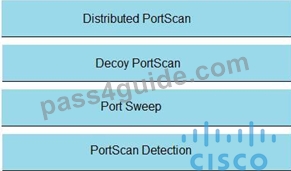
Drag and drop the Firepower Next Generation Intrustion Prevention System detectors from the left onto the correct definitions on the right.
Answer:
Explanation:
NEW QUESTION 275
How does Cisco Stealthwatch Cloud provide security for cloud environments?
- A. It facilitates secure connectivity between public and private networks.
- B. It assigns Internet-based DNS protection for clients and servers.
- C. It prevents exfiltration of sensitive data.
- D. It delivers visibility and threat detection.
Answer: D
Explanation:
Explanation/Reference: https://www.content.shi.com/SHIcom/ContentAttachmentImages/SharedResources/FBLP/Cisco/ Cisco-091919-Simple-IT-Whitepaper.pdf
NEW QUESTION 276
Drag and drop the cloud security assessment components from the left onto the definitions on the right.
Answer:
Explanation: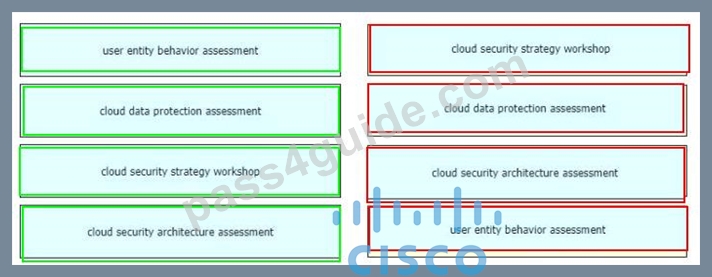
NEW QUESTION 277
For Cisco IOS PKI, which two types of Servers are used as a distribution point for CRLs? (Choose two)
- A. HTTP
- B. subordinate CA
- C. SCP
- D. LDAP
- E. SDP
Answer: A,D
Explanation:
Cisco IOS public key infrastructure (PKI) provides certificate management to support security protocols such as IP Security (IPSec), secure shell (SSH), and secure socket layer (SSL). This module identifies and describes concepts that are needed to understand, plan for, and implement a PKI.
A PKI is composed of the following entities: ...
- A distribution mechanism (such as Lightweight Directory Access Protocol [LDAP] or HTTP) for certificate revocation lists (CRLs) Cisco IOS public key infrastructure (PKI) provides certificate management to support security protocols such as IP Security (IPSec), secure shell (SSH), and secure socket layer (SSL). This module identifies and describes concepts that are needed to understand, plan for, and implement a PKI.
A PKI is composed of the following entities: ...
- A distribution mechanism (such as Lightweight Directory Access Protocol [LDAP] or HTTP) for certificate revocation lists (CRLs) Reference:
Cisco IOS public key infrastructure (PKI) provides certificate management to support security protocols such as IP Security (IPSec), secure shell (SSH), and secure socket layer (SSL). This module identifies and describes concepts that are needed to understand, plan for, and implement a PKI.
A PKI is composed of the following entities: ...
- A distribution mechanism (such as Lightweight Directory Access Protocol [LDAP] or HTTP) for certificate revocation lists (CRLs)
NEW QUESTION 278
An organization is using DNS services for their network and want to help improve the security of the DNS infrastructure. Which action accomplishes this task?
- A. Configure Cisco Umbrella and use DNSSEC for domain authentication to authoritative servers.
- B. Use DNSSEC between the endpoints and Cisco Umbrella DNS servers.
- C. Modify the Cisco Umbrella configuration to pass queries only to non-DNSSEC capable zones.
- D. Integrate Cisco Umbrella with Cisco CloudLock to ensure that DNSSEC is functional.
Answer: A
NEW QUESTION 279
Which two features of Cisco Email Security can protect your organization against email threats? (Choose two)
- A. Heuristic-based filtering
- B. Geolocation-based filtering
- C. NetFlow
- D. Data loss prevention
- E. Time-based one-time passwords
Answer: B,D
Explanation:
Protect sensitive content in outgoing emails with Data Loss Prevention (DLP) and easy-to-use email encryption, all in one solution. Cisco Email Security appliance can now handle incoming mail connections and incoming messages from specific geolocations and perform appropriate actions on them, for example: - Prevent email threats coming from specific geographic regions. - Allow or disallow emails coming from specific geographic regions. Reference: https://www.cisco.com/c/en/us/td/docs/security/esa/esa11-0/user_guide_fs/ b_ESA_Admin_Guide_11_0/b_ESA_Admin_Guide_chapter_00.html encryption, all in one solution.
Cisco Email Security appliance can now handle incoming mail connections and incoming messages from specific geolocations and perform appropriate actions on them, for example:
- Prevent email threats coming from specific geographic regions.
- Allow or disallow emails coming from specific geographic regions.
Reference:
Protect sensitive content in outgoing emails with Data Loss Prevention (DLP) and easy-to-use email encryption, all in one solution. Cisco Email Security appliance can now handle incoming mail connections and incoming messages from specific geolocations and perform appropriate actions on them, for example: - Prevent email threats coming from specific geographic regions. - Allow or disallow emails coming from specific geographic regions. Reference: https://www.cisco.com/c/en/us/td/docs/security/esa/esa11-0/user_guide_fs/ b_ESA_Admin_Guide_11_0/b_ESA_Admin_Guide_chapter_00.html
NEW QUESTION 280
......
350-701 Dumps are Available for Instant Access: https://vcepractice.pass4guide.com/350-701-dumps-questions.html