


Obtain the 350-701 PDF Dumps Get 100% Outcomes Exam Questions For You To Pass
350-701 Exam Dumps Contains FREE Real Quesions from the Actual Exam
NEW QUESTION 299
Drag and drop the common security threats from left onto the definitions on the right.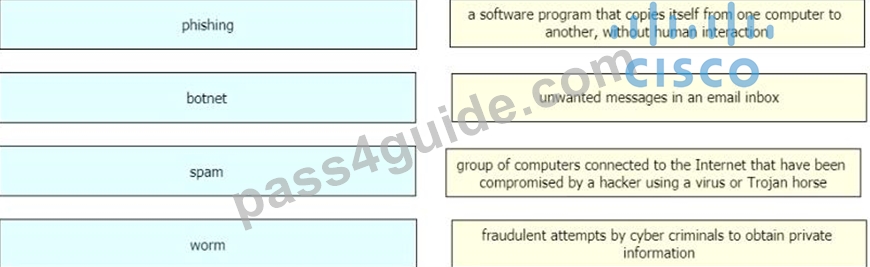
Answer:
Explanation:
NEW QUESTION 300
Which command enables 802.1X globally on a Cisco switch?
- A. dot1x pae authenticator
- B. authentication port-control auto
- C. aaa new-model
- D. dot1x system-auth-control
Answer: D
Explanation:
Explanation/Reference: https://www.cisco.com/c/en/us/td/docs/routers/nfvis/switch_command/b-nfvis-switch-command- reference/802_1x_commands.html
NEW QUESTION 301
Drag and drop the steps from the left into the correct order on the right to enable AppDynamics to monitor an EC2 instance in Amazon Web Services.
Answer:
Explanation:
NEW QUESTION 302
Which two methods must be used to add switches into the fabric so that administrators can control how switches are added into DCNM for private cloud management? (Choose two.)
- A. Cisco Prime Infrastructure
- B. Seed IP
- C. PowerOn Auto Provisioning
- D. Cisco Cloud Director
- E. CDP AutoDiscovery
Answer: B,C
NEW QUESTION 303
An organization wants to secure users, data, and applications in the cloud. The solution must be API-based and operate as a cloud-native CASB. Which solution must be used for this implementation?
- A. Cisco Cloudlock
- B. Cisco Firepower Next-Generation Firewall
- C. Cisco Umbrella
- D. Cisco Cloud Email Security
Answer: A
Explanation:
Explanation Cisco Cloudlock: Secure your cloud users, data, and applications with the cloud-native Cloud Access Security Broker (CASB) and cloud cybersecurity platform. Reference: https://www.cisco.com/c/dam/en/us/products/collateral/security/cloud-web-security/at-a-glance-c45- 738565.pdf Cisco Cloudlock: Secure your cloud users, data, and applications with the cloud-native Cloud Access Security Broker (CASB) and cloud cybersecurity platform.
Reference:
Explanation Cisco Cloudlock: Secure your cloud users, data, and applications with the cloud-native Cloud Access Security Broker (CASB) and cloud cybersecurity platform. Reference: https://www.cisco.com/c/dam/en/us/products/collateral/security/cloud-web-security/at-a-glance-c45- 738565.pdf
NEW QUESTION 304
In an laaS cloud services modal, which security function is the provider responsible for managing?
- A. CASB
- B. hypervisor OS hardening
- C. firewalling virtual machines
- D. Internet proxy
Answer: B
Explanation:
Infrastructure as a Service (IaaS) in cloud computing is one of the most significant and fastest growing field. In this service model, cloud providers offer resources to users/machines that include computers as virtual machines, raw (block) storage, firewalls, load balancers, and network devices.
NEW QUESTION 305
A network administrator is using the Cisco ESA with AMP to upload files to the cloud for analysis. The network is congested and is affecting communication. How will the Cisco ESA handle any files which need analysis?
- A. The file is queued for upload when connectivity is restored.
- B. The ESA immediately makes another attempt to upload the file.
- C. AMP calculates the SHA-256 fingerprint, caches it, and periodically attempts the upload.
- D. The file upload is abandoned.
Answer: D
Explanation:
Explanation The appliance will try once to upload the file; if upload is not successful, for example because of connectivity problems, the file may not be uploaded. If the failure was because the file analysis server was overloaded, the upload will be attempted once more. Reference: https://www.cisco.com/c/en/us/support/docs/security/email-security-appliance/118796-technoteesa-00.html In this question, it stated "the network is congested" (not the file analysis server was overloaded) so the appliance will not try to upload the file again.
The appliance will try once to upload the file; if upload is not successful, for example because of connectivity problems, the file may not be uploaded. If the failure was because the file analysis server was overloaded, the upload will be attempted once more.
Reference:
In this question, it stated "the network is congested" (not the file analysis server was overloaded) so the Explanation The appliance will try once to upload the file; if upload is not successful, for example because of connectivity problems, the file may not be uploaded. If the failure was because the file analysis server was overloaded, the upload will be attempted once more. Reference: https://www.cisco.com/c/en/us/support/docs/security/email-security-appliance/118796-technoteesa-00.html In this question, it stated "the network is congested" (not the file analysis server was overloaded) so the appliance will not try to upload the file again.
NEW QUESTION 306
With Cisco AMP for Endpoints, which option shows a list of all files that have been executed in your environment?
- A. detections
- B. file analysis
- C. threat root cause
- D. prevalence
- E. vulnerable software
Answer: D
NEW QUESTION 307
How does Cisco Umbrella archive logs to an enterprise owned storage?
- A. by the system administrator downloading the logs from the Cisco Umbrella web portal
- B. by using the Application Programming Interface to fetch the logs
- C. by being configured to send logs to a self-managed AWS S3 bucket
- D. by sending logs via syslog to an on-premises or cloud-based syslog server
Answer: C
Explanation:
The Cisco Umbrella Multi-Org console has the ability to upload, store, and archive traffic activity logs from your organizations' Umbrella dashboards to the cloud through Amazon S3. CSV formatted Umbrella logs are compressed (gzip) and uploaded every ten minutes so that there's a minimum of delay between traffic from the organization's Umbrella dashboard being logged and then being available to download from an S3 bucket.
By having your organizations' logs uploaded to an S3 bucket, you can then download logs automatically to keep in perpetuity in backup storage.
The Cisco Umbrella Multi-Org console has the ability to upload, store, and archive traffic activity logs from your organizations' Umbrella dashboards to the cloud through Amazon S3. CSV formatted Umbrella logs are compressed (gzip) and uploaded every ten minutes so that there's a minimum of delay between traffic from the organization's Umbrella dashboard being logged and then being available to download from an S3 bucket.
By having your organizations' logs uploaded to an S3 bucket, you can then download logs automatically to keep in perpetuity in backup storage.
Reference:
The Cisco Umbrella Multi-Org console has the ability to upload, store, and archive traffic activity logs from your organizations' Umbrella dashboards to the cloud through Amazon S3. CSV formatted Umbrella logs are compressed (gzip) and uploaded every ten minutes so that there's a minimum of delay between traffic from the organization's Umbrella dashboard being logged and then being available to download from an S3 bucket.
By having your organizations' logs uploaded to an S3 bucket, you can then download logs automatically to keep in perpetuity in backup storage.
NEW QUESTION 308
A network administrator is configuring a rule in an access control policy to block certain URLs and selects the
"Chat and Instant Messaging" category. Which reputation score should be selected to accomplish this goal?
- A. 0
- B. 1
- C. 2
- D. 3
Answer: D
Explanation:
Explanation
https://www.cisco.com/c/en/us/td/docs/security/esa/esa111/user_guide/b_ESA_Admin_Guide_11_1/b_ESA_Adm
NEW QUESTION 309
When Cisco and other industry organizations publish and inform users of known security findings and vulnerabilities, which name is used?
- A. Common Security Exploits
- B. Common Vulnerabilities and Exposures
- C. Common Exploits and Vulnerabilities
- D. Common Vulnerabilities, Exploits and Threats
Answer: B
Explanation:
Reference:
https://www.cisco.com/c/en/us/td/docs/ios-xml/ios/cve/174/cve-addressed-1741.html
NEW QUESTION 310
How is Cisco Umbrella configured to log only security events?
- A. in the Security Settings section
- B. per policy
- C. in the Reporting settings
- D. per network in the Deployments section
Answer: B
NEW QUESTION 311
What is a difference between DMVPN and sVTI?
- A. DMVPN supports tunnel encryption, whereas sVTI does not.
- B. DMVPN supports dynamic tunnel establishment, whereas sVTI does not.
- C. DMVPN provides interoperability with other vendors, whereas sVTI does not.
- D. DMVPN supports static tunnel establishment, whereas sVTI does not.
Answer: B
NEW QUESTION 312
Which statement about IOS zone-based firewalls is true?
- A. An interface can be assigned to multiple zones.
- B. An unassigned interface can communicate with assigned interfaces
- C. An interface can be assigned only to one zone.
- D. Only one interface can be assigned to a zone.
Answer: C
Explanation:
Explanation/Reference: https://www.cisco.com/c/en/us/support/docs/security/ios-firewall/98628-zone-design-guide.html
NEW QUESTION 313
An organization is using Cisco Firepower and Cisco Meraki MX for network security and needs to centrally manage cloud policies across these platforms. Which software should be used to accomplish this goal?
- A. Cisco DNA Center
- B. Cisco Configuration Professional
- C. Cisco Secureworks
- D. Cisco Defense Orchestrator
Answer: D
Explanation:
Explanation Explanation Cisco Defense Orchestrator is a cloud-based management solution that allows you to manage security policies and device configurations with ease across multiple Cisco and cloud-native security platforms. Cisco Defense Orchestrator features: .... Management of hybrid environments: Managing a mix of firewalls running the ASA, FTD, and Meraki MX software is now easy, with the ability to share policy elements across platforms. Reference: https://www.cisco.com/c/en/us/products/collateral/security/defense-orchestrator/datasheet-c78- 736847.html Explanation Cisco Defense Orchestrator is a cloud-based management solution that allows you to manage security policies and device configurations with ease across multiple Cisco and cloud-native security platforms.
Cisco Defense Orchestrator features:
....
Management of hybrid environments: Managing a mix of firewalls running the ASA, FTD, and Meraki MX software is now easy, with the ability to share policy elements across platforms.
Reference:
Explanation Explanation Cisco Defense Orchestrator is a cloud-based management solution that allows you to manage security policies and device configurations with ease across multiple Cisco and cloud-native security platforms. Cisco Defense Orchestrator features: .... Management of hybrid environments: Managing a mix of firewalls running the ASA, FTD, and Meraki MX software is now easy, with the ability to share policy elements across platforms. Reference: https://www.cisco.com/c/en/us/products/collateral/security/defense-orchestrator/datasheet-c78- 736847.html
NEW QUESTION 314
Which two endpoint measures are used to minimize the chances of falling victim to phishing and social engineering attacks? (Choose two.)
- A. Patch for cross-site scripting.
- B. Protect against input validation and character escapes in the endpoint.
- C. Protect systems with an up-to-date antimalware program.
- D. Perform backups to the private cloud.
- E. Install a spam and virus email filter.
Answer: B,C
NEW QUESTION 315
......
Content Security – 10%
- Describing the capacity, benefits, and components of Cisco Umbrella;
- Explaining web proxy authentication & identity, including transparent user identification;
- Comparing the capacity, benefits, and components of Cloud-based & local email as well as web solutions;
- Configuring and verifying the secure internet gateway as well as web security features, such as URL categorization, block listing, malware scanning, URL filtering, TLS decryption, and web application filtering;
Understanding functional and technical aspects of Implementing and Operating Cisco Security Core Technologies (SCOR 350-701) Securing the Cloud
The following will be discussed in CISCO 350-701 exam dumps:
- Describe application and workload security concepts
- Compare the customer vs. provider security responsibility for the different cloud service models
- Identify security capabilities, deployment models, and policy management to secure the cloud
- Implement application and data security in cloud environments
- Public, private, hybrid, and community clouds
- Describe the concept of DevSecOps (CI/CD pipeline, container orchestration, and security
- Cloud-delivered security solutions such as firewall, management, proxy, security intelligence, and CASB
- Identify security solutions for cloud environments
- Security assessment in the cloud
Use Real Cisco Achieve the 350-701 Dumps - 100% Exam Passing Guarantee: https://vcepractice.pass4guide.com/350-701-dumps-questions.html