


Professional-Machine-Learning-Engineer Self-Study Guide for Becoming an Google Professional Machine Learning Engineer Expert
Professional-Machine-Learning-Engineer Study Guide Realistic Verified Professional-Machine-Learning-Engineer Dumps
Google Professional Machine Learning Engineer certification is a valuable asset for professionals who are looking to advance their careers in the field of machine learning. Google Professional Machine Learning Engineer certification validates the candidate's expertise in designing, building, and deploying machine learning models using the Google Cloud Platform. If you are a data scientist, machine learning engineer, or software developer looking to enhance your skills in machine learning, then the Google Professional Machine Learning Engineer certification is definitely worth considering.
To be eligible for the exam, candidates must have experience in developing and deploying machine learning models using Google Cloud Platform. They should also have experience with programming languages such as Python and SQL, and knowledge of machine learning concepts such as supervised and unsupervised learning, reinforcement learning, and deep learning.
Google Professional Machine Learning Engineer certification exam is a great way for professionals to showcase their skills and knowledge in the field of machine learning. Professional-Machine-Learning-Engineer exam is designed to test the individual's ability to use Google Cloud Platform tools and services to create scalable and efficient machine learning models. Google Professional Machine Learning Engineer certification exam provides a credible and recognized way for professionals to demonstrate their expertise in the field of machine learning.
NEW QUESTION # 91
A gaming company has launched an online game where people can start playing for free, but they need to pay if they choose to use certain features. The company needs to build an automated system to predict whether or not a new user will become a paid user within 1 year. The company has gathered a labeled dataset from 1 million users.
The training dataset consists of 1,000 positive samples (from users who ended up paying within 1 year) and
999,000 negative samples (from users who did not use any paid features). Each data sample consists of 200 features including user age, device, location, and play patterns.
Using this dataset for training, the Data Science team trained a random forest model that converged with over
99% accuracy on the training set. However, the prediction results on a test dataset were not satisfactory Which of the following approaches should the Data Science team take to mitigate this issue? (Choose two.)
- A. Add more deep trees to the random forest to enable the model to learn more features.
- B. Include a copy of the samples in the test dataset in the training dataset.
- C. Generate more positive samples by duplicating the positive samples and adding a small amount of noise to the duplicated data.
- D. Change the cost function so that false negatives have a higher impact on the cost value than false positives.
- E. Change the cost function so that false positives have a higher impact on the cost value than false negatives.
Answer: C,D
NEW QUESTION # 92
You work for a magazine publisher and have been tasked with predicting whether customers will cancel their annual subscription. In your exploratory data analysis, you find that 90% of individuals renew their subscription every year, and only 10% of individuals cancel their subscription. After training a NN Classifier, your model predicts those who cancel their subscription with 99% accuracy and predicts those who renew their subscription with 82% accuracy. How should you interpret these results?
- A. This is a good result because the accuracy across both groups is greater than 80%.
- B. This is not a good result because the model should have a higher accuracy for those who renew their subscription than for those who cancel their subscription.
- C. This is a good result because predicting those who cancel their subscription is more difficult, since there is less data for this group.
- D. This is not a good result because the model is performing worse than predicting that people will always renew their subscription.
Answer: D
Explanation:
In this case, the model has a high accuracy of 99% for identifying customers who cancel their subscriptions, but a lower accuracy of 82% for identifying customers who renew their subscriptions. However, this does not necessarily mean that the model is performing well, because 90% of the customers renew their subscription, so if the model always predicts that customers will renew, it will be correct 90% of the time. Therefore, the model's performance is worse than the baseline of always predicting that customers will renew their subscription.
https://en.wikipedia.org/wiki/Imbalanced_data
https://machinelearningmastery.com/baseline-performance-machine-learning-algorithms/
NEW QUESTION # 93
A Machine Learning Specialist working for an online fashion company wants to build a data ingestion solution for the company's Amazon S3-based data lake.
The Specialist wants to create a set of ingestion mechanisms that will enable future capabilities comprised of:
* Real-time analytics
* Interactive analytics of historical data
* Clickstream analytics
* Product recommendations
Which services should the Specialist use?
- A. AWS Glue as the data catalog; Amazon Kinesis Data Streams and Amazon Kinesis Data Analytics for real- time data insights; Amazon Kinesis Data Firehose for delivery to Amazon ES for clickstream analytics; Amazon EMR to generate personalized product recommendations
- B. Amazon Athena as the data catalog: Amazon Kinesis Data Streams and Amazon Kinesis Data Analytics for near-real-time data insights; Amazon Kinesis Data Firehose for clickstream analytics; AWS Glue to generate personalized product recommendations
- C. AWS Glue as the data catalog; Amazon Kinesis Data Streams and Amazon Kinesis Data Analytics for historical data insights; Amazon Kinesis Data Firehose for delivery to Amazon ES for clickstream analytics; Amazon EMR to generate personalized product recommendations
- D. Amazon Athena as the data catalog; Amazon Kinesis Data Streams and Amazon Kinesis Data Analytics for historical data insights; Amazon DynamoDB streams for clickstream analytics; AWS Glue to generate personalized product recommendations
Answer: A
NEW QUESTION # 94
Your team is training a large number of ML models that use different algorithms, parameters and datasets.
Some models are trained in Vertex Ai Pipelines, and some are trained on Vertex Al Workbench notebook instances. Your team wants to compare the performance of the models across both services. You want to minimize the effort required to store the parameters and metrics What should you do?
- A. Store all model parameters and metrics as mode! metadata by using the Vertex Al Metadata API.
- B. Create a Vertex Al experiment Submit all the pipelines as experiment runs. For models trained on notebooks log parameters and metrics by using the Vertex Al SDK.
- C. Implement an additional step for all the models running in pipelines and notebooks to export parameters and metrics to BigQuery.
- D. Implement all models in Vertex Al Pipelines Create a Vertex Al experiment, and associate all pipeline runs with that experiment.
Answer: B
Explanation:
Vertex AI Experiments is a service that allows you to track, compare, and manage experiments with Vertex AI. You can use Vertex AI Experiments to record the parameters, metrics, and artifacts of each model training run, and compare them in a graphical interface. Vertex AI Experiments supports models trained in Vertex AI Pipelines, Vertex AI Custom Training, and Vertex AI Workbench notebooks. To use Vertex AI Experiments, you need to create an experiment and submit your pipeline runs or custom training jobs as experiment runs.
For models trained on notebooks, you need to use the Vertex AI SDK to log the parameters and metrics to the experiment. This way, you can minimize the effort required to store and compare the model performance across different services. References: Track, compare, manage experiments with Vertex AI Experiments, Vertex AI Pipelines: Metrics visualization and run comparison using the KFP SDK, [Vertex AI SDK for Python]
NEW QUESTION # 95
You are developing an ML model using a dataset with categorical input variables. You have randomly split half of the data into training and test sets. After applying one-hot encoding on the categorical variables in the training set, you discover that one categorical variable is missing from the test set. What should you do?
- A. Use sparse representation in the test set
- B. Apply one-hot encoding on the categorical variables in the test data.
- C. Collect more data representing all categories
- D. Randomly redistribute the data, with 70% for the training set and 30% for the test set
Answer: B
Explanation:
This approach ensures that the model is able to accurately interpret the categorical data in the test set. As the training set already contains one-hot encoded data, it is important to apply the same encoding to the test set so the model can interpret the data accurately. Reference: https://machinelearningmastery.com/how-to-one-hot-encode-sequence-data-in-python/https://machinelearningmastery.com/how-to-use-one-hot-encoding-for-categorical-data/.
When working with categorical input variables, it's important to ensure that the same preprocessing steps are applied to both the training and test sets. One-hot encoding is a common method used to convert categorical variables into numerical values, which can then be used as inputs to machine learning models. By applying one-hot encoding to the test set, you will ensure that the test data has the same format as the training data and that the model can make accurate predictions.
NEW QUESTION # 96
You work for a social media company. You want to create a no-code image classification model for an iOS mobile application to identify fashion accessories You have a labeled dataset in Cloud Storage You need to configure a training workflow that minimizes cost and serves predictions with the lowest possible latency What should you do?
- A. Train the model by using AutoML Edge and export the model as a TFLite model Configure your mobile application to use the tflite file directly
- B. Train the model by using AutoML, and expose the model as a Vertex Al endpoint Configure your mobile application to invoke the endpoint during prediction.
- C. Train the model by using AutoML, and register the model in Vertex Al Model Registry Configure your mobile application to send batch requests during prediction.
- D. Train the model by using AutoML Edge and export it as a Core ML model Configure your mobile application to use the mlmodel file directly.
Answer: D
NEW QUESTION # 97
You work for a gaming company that develops massively multiplayer online (MMO) games. You built a TensorFlow model that predicts whether players will make in-app purchases of more than $10 in the next two weeks. The model's predictions will be used to adapt each user's game experience. User data is stored in BigQuery. How should you serve your model while optimizing cost, user experience, and ease of management?
- A. Embed the model in the streaming Dataflow pipeline. Make predictions after every in-app purchase event is published in Pub/Sub, and push the data to Cloud SQL.
- B. Embed the model in the mobile application. Make predictions after every in-app purchase event is published in Pub/Sub, and push the data to Cloud SQL.
- C. Deploy the model to Vertex AI Prediction. Make predictions using batch reading data from Cloud Bigtable, and push the data to Cloud SQL.
- D. Import the model into BigQuery ML. Make predictions using batch reading data from BigQuery, and push the data to Cloud SQL
Answer: D
NEW QUESTION # 98
A machine learning (ML) specialist wants to secure calls to the Amazon SageMaker Service API. The specialist has configured Amazon VPC with a VPC interface endpoint for the Amazon SageMaker Service API and is attempting to secure traffic from specific sets of instances and IAM users. The VPC is configured with a single public subnet.
Which combination of steps should the ML specialist take to secure the traffic? (Choose two.)
- A. Add a VPC endpoint policy to allow access to the IAM users.
- B. Modify the users' IAM policy to allow access to Amazon SageMaker Service API calls only.
- C. Modify the security group on the endpoint network interface to restrict access to the instances.
- D. Modify the ACL on the endpoint network interface to restrict access to the instances.
- E. Add a SageMaker Runtime VPC endpoint interface to the VPC.
Answer: A,C
Explanation:
Explanation/Reference: https://aws.amazon.com/blogs/machine-learning/private-package-installation-in-amazon- sagemaker-running-in-internet-free-mode/
NEW QUESTION # 99
You are working with a dataset that contains customer transactions. You need to build an ML model to predict customer purchase behavior You plan to develop the model in BigQuery ML, and export it to Cloud Storage for online prediction You notice that the input data contains a few categorical features, including product category and payment method You want to deploy the model as quickly as possible. What should you do?
- A. Use the ML. ONE_HOT_ENCODER function on the categorical features, and select the encoded categorical features and non-categorical features as inputs to create your model.
- B. Use the ML. ONE_HOT_ENCODER function on the categorical features, and select the encoded categorical features and non-categorical features as inputs to create your model.
- C. Use the transform clause with the ML. ONE_HOT_ENCODER function on the categorical features at model creation and select the categorical and non-categorical features.
- D. Use the create model statement and select the categorical and non-categorical features.
Answer: C
Explanation:
The best option for building an ML model to predict customer purchase behavior in BigQuery ML is to use the transform clause with the ML.ONE_HOT_ENCODER function on the categorical features at model creation and select the categorical and non-categorical features. This option allows you to encode the categorical features as one-hot vectors, which are binary vectors that have only one non-zero element. One-hot encoding is a common technique for handling categorical features in ML models, as it can reduce the dimensionality and sparsity of the data, and avoid the ordinality problem that arises when using numerical labels for categorical values1. The transform clause is a feature of BigQuery ML that lets you apply SQL expressions to transform the input data at model creation time. The transform clause can perform feature engineering, such as one-hot encoding, on the fly, without requiring you to create and store a new table with the transformed data2. By using the transform clause with the ML.ONE_HOT_ENCODER function, you can create and train an ML model in BigQuery ML with a single SQL statement, and export it to Cloud Storage for online prediction.
The other options are not as good as option A, for the following reasons:
* Option B: Using the ML.ONE_HOT_ENCODER function on the categorical features, and selecting the encoded categorical features and non-categorical features as inputs to create your model, would require more steps and storage than using the transform clause. TheML.ONE_HOT_ENCODER function is a BigQuery ML function that returns a one-hot encoded vector for a given categorical value. However, using this function alone would not apply the one-hot encoding to the input data at model creation time.
You would need to create a new table with the encoded features, and use that table as the input to create your model. This would incur additional storage costs and reduce the performance of the queries.
* Option C: Using the create model statement and selecting the categorical and non-categorical features, would not handle the categorical features properly and could result in a poor model performance. The create model statement is a BigQuery ML statement that creates and trains an ML model from a SQL query. However, if the input data contains categorical features, you need to encode them as one-hot vectors or use the category_count option to specify the number of categories for each feature. Otherwise, BigQuery ML would treat the categorical features as numerical values, which can introduce bias and noise into the model3.
* Option D: Using the ML.ONE_HOT_ENCODER function on the categorical features, and selecting the encoded categorical features and non-categorical features as inputs to create your model, is the same as option B, and has the same drawbacks.
References:
* Preparing for Google Cloud Certification: Machine Learning Engineer, Course 2: Data Engineering for ML on Google Cloud, Week 2: Feature Engineering
* Google Cloud Professional Machine Learning Engineer Exam Guide, Section 1: Architecting low-code ML solutions, 1.1 Developing ML models by using BigQuery ML
* Official Google Cloud Certified Professional Machine Learning Engineer Study Guide, Chapter 3: Data Engineering for ML, Section 3.2: BigQuery for ML
* One-hot encoding
* Using the TRANSFORM clause for feature engineering
* Creating a model
* ML.ONE_HOT_ENCODER function
NEW QUESTION # 100
You work as an analyst at a large banking firm. You are developing a robust, scalable ML pipeline to train several regression and classification models. Your primary focus for the pipeline is model interpretability. You want to productionize the pipeline as quickly as possible What should you do?
- A. Use Google Kubernetes Engine to build a custom training pipeline for XGBoost-based models.
- B. Use Tabular Workflow forTabel through Vertex Al Pipelines to train attention-based models.
- C. Use Tabular Workflow for Wide & Deep through Vertex Al Pipelines to jointly train wide linear models and deep neural networks.
- D. Use Cloud Composer to build the training pipelines for custom deep learning-based models.
Answer: B
NEW QUESTION # 101
You have trained a deep neural network model on Google Cloud. The model has low loss on the training data, but is performing worse on the validation dat a. You want the model to be resilient to overfitting. Which strategy should you use when retraining the model?
- A. Apply a dropout parameter of 0 2, and decrease the learning rate by a factor of 10
- B. Apply a 12 regularization parameter of 0.4, and decrease the learning rate by a factor of 10.
- C. Run a hyperparameter tuning job on Al Platform to optimize for the L2 regularization and dropout parameters
- D. Run a hyperparameter tuning job on Al Platform to optimize for the learning rate, and increase the number of neurons by a factor of 2.
Answer: D
NEW QUESTION # 102
You are a lead ML engineer at a retail company. You want to track and manage ML metadata in a centralized way so that your team can have reproducible experiments by generating artifacts. Which management solution should you recommend to your team?
- A. Manage your ML workflows with Vertex ML Metadata.
- B. Manage all relational entities in the Hive Metastore.
- C. Store all ML metadata in Google Cloud's operations suite.
- D. Store your tf.logging data in BigQuery.
Answer: C
NEW QUESTION # 103
A Data Science team within a large company uses Amazon SageMaker notebooks to access data stored in Amazon S3 buckets. The IT Security team is concerned that internet-enabled notebook instances create a security vulnerability where malicious code running on the instances could compromise data privacy. The company mandates that all instances stay within a secured VPC with no internet access, and data communication traffic must stay within the AWS network.
How should the Data Science team configure the notebook instance placement to meet these requirements?
- A. Associate the Amazon SageMaker notebook with a private subnet in a VPC. Place the Amazon SageMaker endpoint and S3 buckets within the same VPC.
- B. Associate the Amazon SageMaker notebook with a private subnet in a VPC. Ensure the VPC has a NAT gateway and an associated security group allowing only outbound connections to Amazon S3 and Amazon SageMaker.
- C. Associate the Amazon SageMaker notebook with a private subnet in a VPC. Use IAM policies to grant access to Amazon S3 and Amazon SageMaker.
- D. Associate the Amazon SageMaker notebook with a private subnet in a VPC. Ensure the VPC has S3 VPC endpoints and Amazon SageMaker VPC endpoints attached to it.
Answer: B
NEW QUESTION # 104
You work on a growing team of more than 50 data scientists who all use AI Platform. You are designing a strategy to organize your jobs, models, and versions in a clean and scalable way. Which strategy should you choose?
- A. Set up a BigQuery sink for Cloud Logging logs that is appropriately filtered to capture information about AI Platform resource usage. In BigQuery, create a SQL view that maps users to the resources they are using
- B. Use labels to organize resources into descriptive categories. Apply a label to each created resource so that users can filter the results by label when viewing or monitoring the resources.
- C. Set up restrictive IAM permissions on the AI Platform notebooks so that only a single user or group can access a given instance.
- D. Separate each data scientist's work into a different project to ensure that the jobs, models, and versions created by each data scientist are accessible only to that user.
Answer: B
Explanation:
Labels are key-value pairs that you can attach to AI Platform resources such as jobs, models, and versions.
Labels can help you organize your resources into descriptive categories that reflect your business needs. For example, you can use labels to indicate the owner, purpose, environment, or status of a resource. You can also use labels to filter the results when you list or monitor your resources on the Google Cloud Console or the Cloud SDK. Using labels can help you manage your resources in a clean and scalable way, without requiring separate projects or restrictive permissions.
References:
* Using labels to organize AI Platform resources
* Creating and managing labels
NEW QUESTION # 105
You are developing a model to help your company create more targeted online advertising campaigns. You need to create a dataset that you will use to train the model. You want to avoid creating or reinforcing unfair bias in the model. What should you do?
Choose 2 answers
- A. Conduct fairness tests across sensitive categories and demographics on the trained model.
- B. Include a comprehensive set of demographic features.
- C. include only the demographic groups that most frequently interact with advertisements.
- D. Collect a stratified sample of production traffic to build the training dataset.
- E. Collect a random sample of production traffic to build the training dataset.
Answer: A,E
Explanation:
To avoid creating or reinforcing unfair bias in the model, you should collect a representative sample of production traffic to build the training dataset, and conduct fairness tests across sensitive categories and demographics on the trained model. A representative sample is one that reflects the true distribution of the population, and does not over- or under-represent any group. A random sample is a simple way to obtain a representative sample, as it ensures that every data point has an equal chance of being selected. A stratified sample is another way to obtain a representative sample, as it ensures that every subgroup has a proportional representation in the sample. However, a stratified sample requires prior knowledge of the subgroups and their sizes, which may not be available or easy to obtain. Therefore, a random sample is a more feasible option in this case. A fairness test is a way to measure and evaluate the potential bias and discrimination of the model, based on different categories and demographics, such as age, gender, race, etc. A fairness test can help you identify and mitigate any unfair outcomes or impacts of the model, and ensure that the model treats all groups fairly and equitably. A fairness test can be conducted using various methods and tools, such as confusion matrices, ROC curves, fairness indicators, etc. References: The answer can be verified from official Google Cloud documentation and resources related to data sampling and fairness testing.
* Sampling data | BigQuery
* Fairness Indicators | TensorFlow
* What-if Tool | TensorFlow
NEW QUESTION # 106
You are going to train a DNN regression model with Keras APIs using this code: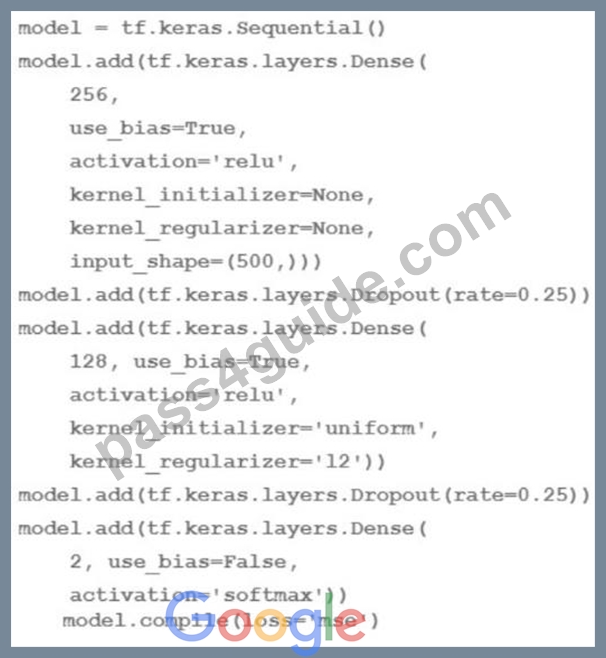
How many trainable weights does your model have? (The arithmetic below is correct.)
- A. 500*256*0 25+256*128*0 25+128*2 = 40448
- B. 501*256+257*128+2 = 161154
- C. 500*256+256*128+128*2 = 161024
- D. 501*256+257*128+128*2=161408
Answer: A
NEW QUESTION # 107
You are responsible for building a unified analytics environment across a variety of on-premises data marts. Your company is experiencing data quality and security challenges when integrating data across the servers, caused by the use of a wide range of disconnected tools and temporary solutions. You need a fully managed, cloud-native data integration service that will lower the total cost of work and reduce repetitive work. Some members on your team prefer a codeless interface for building Extract, Transform, Load (ETL) process. Which service should you use?
- A. Apache Flink
- B. Dataprep
- C. Cloud Data Fusion
- D. Dataflow
Answer: C
Explanation:
https://cloud.google.com/data-fusion/docs/concepts/overview#using_the_code-free_web_ui
NEW QUESTION # 108
You work for an online retail company that is creating a visual search engine. You have set up an end-to-end ML pipeline on Google Cloud to classify whether an image contains your company's product. Expecting the release of new products in the near future, you configured a retraining functionality in the pipeline so that new data can be fed into your ML models. You also want to use Al Platform's continuous evaluation service to ensure that the models have high accuracy on your test data set. What should you do?
- A. Update your test dataset with images of the newer products when your evaluation metrics drop below a pre-decided threshold.
- B. Replace your test dataset with images of the newer products when they are introduced to retraining.
- C. Keep the original test dataset unchanged even if newer products are incorporated into retraining
- D. Extend your test dataset with images of the newer products when they are introduced to retraining
Answer: D
NEW QUESTION # 109
You have been given a dataset with sales predictions based on your company's marketing activities. The data is structured and stored in BigQuery, and has been carefully managed by a team of data analysts. You need to prepare a report providing insights into the predictive capabilities of the dat a. You were asked to run several ML models with different levels of sophistication, including simple models and multilayered neural networks. You only have a few hours to gather the results of your experiments. Which Google Cloud tools should you use to complete this task in the most efficient and self-serviced way?
- A. Use Vertex AI Workbench user-managed notebooks with scikit-learn code for a variety of ML algorithms and performance metrics.
- B. Read the data from BigQuery using Dataproc, and run several models using SparkML.
- C. Use BigQuery ML to run several regression models, and analyze their performance.
- D. Train a custom TensorFlow model with Vertex AI, reading the data from BigQuery featuring a variety of ML algorithms.
Answer: C
NEW QUESTION # 110
A company wants to classify user behavior as either fraudulent or normal. Based on internal research, a Machine Learning Specialist would like to build a binary classifier based on two features: age of account and transaction month. The class distribution for these features is illustrated in the figure provided.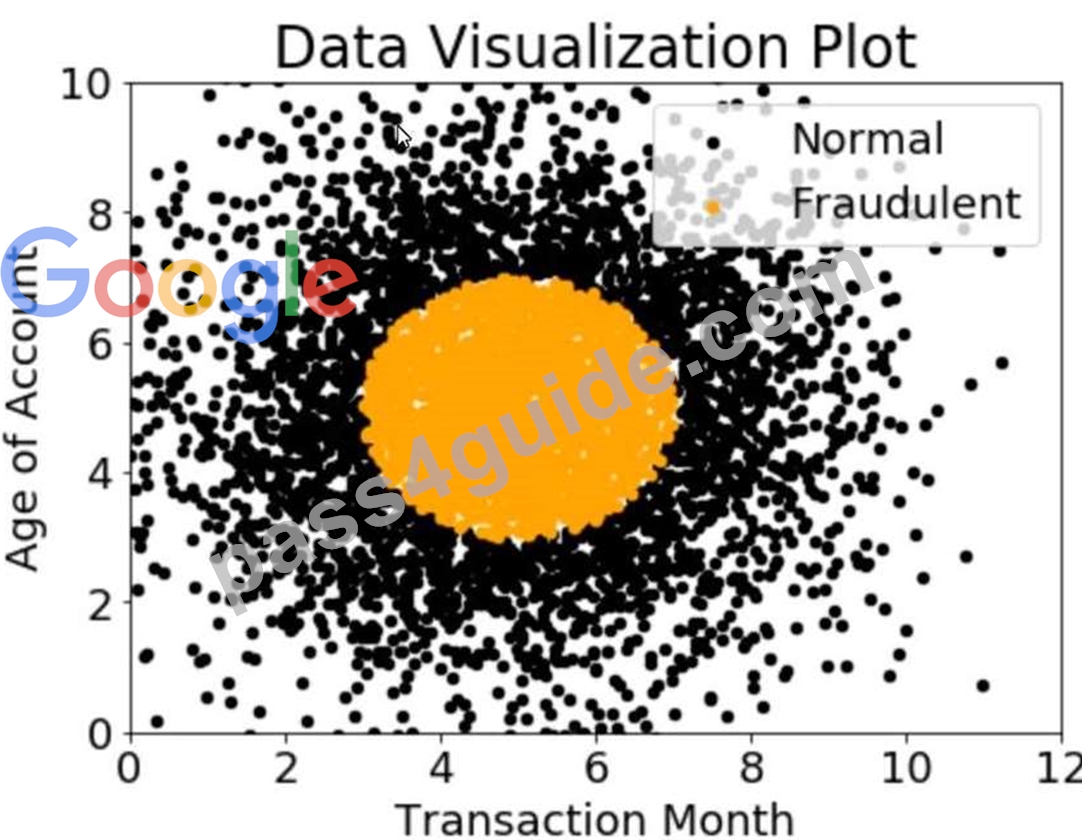
Based on this information, which model would have the HIGHEST accuracy?
- A. Support vector machine (SVM) with non-linear kernel
- B. Logistic regression
- C. Single perceptron with tanh activation function
- D. Long short-term memory (LSTM) model with scaled exponential linear unit (SELU)
Answer: A
NEW QUESTION # 111
You are building a linear model with over 100 input features, all with values between -1 and 1. You suspect that many features are non-informative. You want to remove the non-informative features from your model while keeping the informative ones in their original form. Which technique should you use?
- A. After building your model, use Shapley values to determine which features are the most informative.
- B. Use L1 regularization to reduce the coefficients of uninformative features to 0.
- C. Use Principal Component Analysis to eliminate the least informative features.
- D. Use an iterative dropout technique to identify which features do not degrade the model when removed.
Answer: A
NEW QUESTION # 112
You work for an advertising company and want to understand the effectiveness of your company's latest advertising campaign. You have streamed 500 MB of campaign data into BigQuery. You want to query the table, and then manipulate the results of that query with a pandas dataframe in an Al Platform notebook. What should you do?
- A. From a bash cell in your Al Platform notebook, use the bq extract command to export the table as a CSV file to Cloud Storage, and then use gsutii cp to copy the data into the notebook Use pandas. read_csv to ingest the file as a pandas dataframe
- B. Export your table as a CSV file from BigQuery to Google Drive, and use the Google Drive API to ingest the file into your notebook instance
- C. Download your table from BigQuery as a local CSV file, and upload it to your Al Platform notebook instance Use pandas. read_csv to ingest the file as a pandas dataframe
- D. Use Al Platform Notebooks' BigQuery cell magic to query the data, and ingest the results as a pandas dataframe
Answer: C
NEW QUESTION # 113
......
Valid Professional-Machine-Learning-Engineer Exam Dumps Ensure you a HIGH SCORE: https://vcepractice.pass4guide.com/Professional-Machine-Learning-Engineer-dumps-questions.html