


AZ-700 Exam Dumps Pass with Updated 2024 Certified Exam Questions
AZ-700 Exam Questions - Real & Updated Questions PDF
Microsoft AZ-700 is a popular certification exam that is designed for IT professionals who want to validate their skills in designing and implementing Microsoft Azure Networking Solutions. AZ-700 exam is ideal for anyone who wants to demonstrate their knowledge of Microsoft Azure Networking technologies and solutions. Passing AZ-700 exam demonstrates that you have the skills and knowledge required to design and implement secure, scalable, and highly available networking solutions in Microsoft Azure.
NEW QUESTION # 12
You have two Azure virtual networks named Vnet1 and Vnet2 in an Azure region that has three availability zones.
You deploy 12 virtual machines to each virtual network, deploying four virtual machines per zone. The virtual machines in Vnet1 host an app named App1. The virtual machines in Vnet2 host an app named App2.
You plan to use Azure Virtual Network NAT to implement outbound connectivity for App1 and App2.
You need to identify the minimum number of subnets and Virtual Network NAT instances required to meet the following requirements:
* A failure of two zones must NOT affect the availability of either App1 or App2.
* A failure of two zones must NOT affect the outbound connectivity of either App1 or App2.
What should you identify? To answer, select the appropriate options in the answer are a.
NOTE: Each correct selection is worth one point.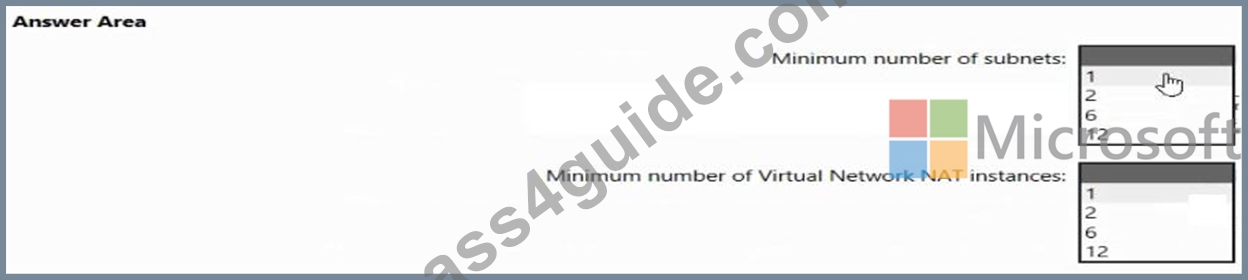
Answer:
Explanation: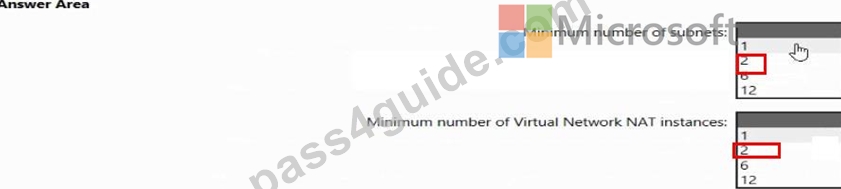
Reference:
https://docs.microsoft.com/en-us/azure/virtual-network/nat-gateway/nat-overview
NEW QUESTION # 13
You need to recommend a configuration for the ExpressRoute connection from the Boston datacenter. The solution must meet the hybrid networking requirements and business requirements.
What should you recommend? To answer, select the appropriate options in the answer area.
NOTE: Each correct selection is worth one point.
Answer:
Explanation:
NEW QUESTION # 14
You create NSG10 and NSG11 to meet the network security requirements.
For each of the following statements, select Yes it the statement is true. Otherwise, select No.
NOTE: Each correct selection is worth one point.
Answer:
Explanation:
NEW QUESTION # 15
You have the network topology shown in the Topology exhibit. (Click the Topology tab.)
You have the Azure firewall shown in the Firewall 1 exhibit. (Click the Firewall tab.)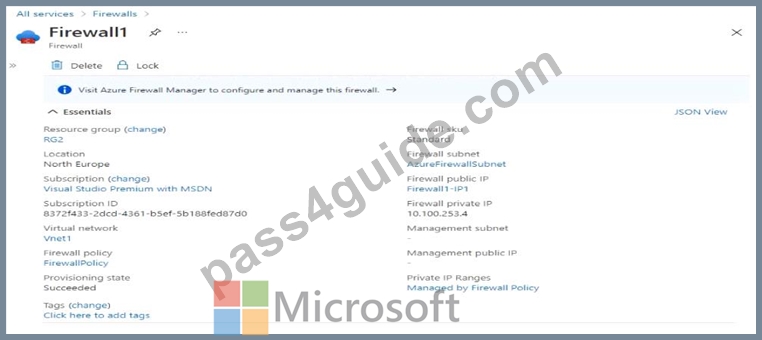
You have the route table shown in the RouteTable1 exhibit. (Click the RouteTable1 tab.)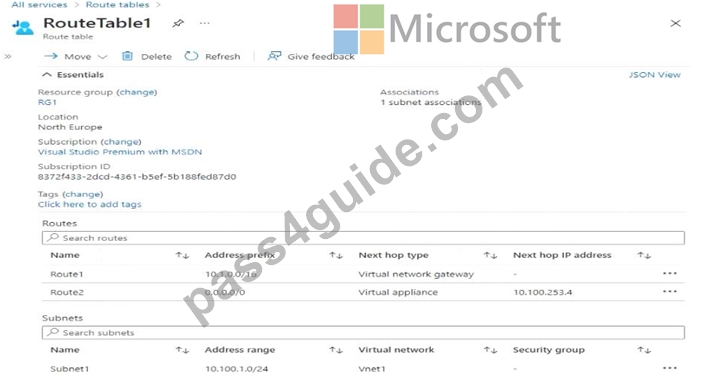
For each of the following statements, select Yes if the statement is true. Otherwise, select No.
NOTE: Each correct selection is worth one point.
Answer:
Explanation: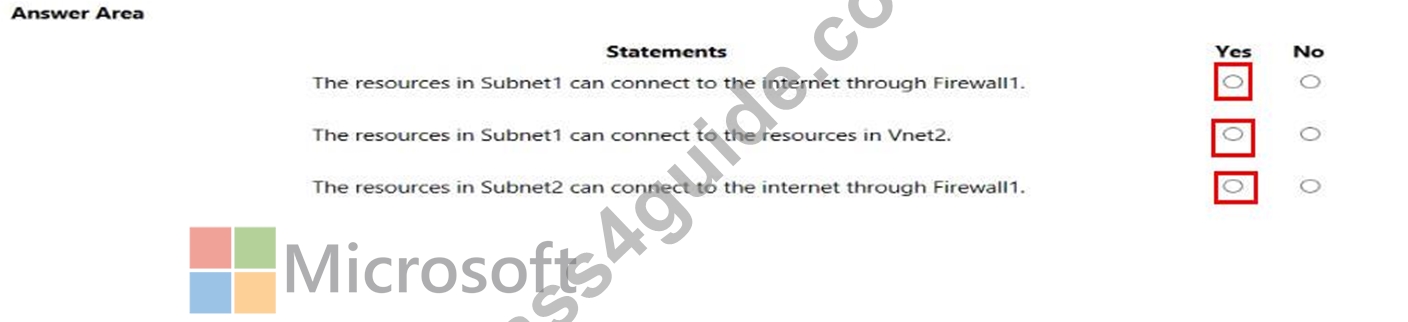
NEW QUESTION # 16
You have an Azure virtual network named Vnet1 that contains two subnets named Subnet1 and Subnet2.
You have the NAT gateway shown in the NATgateway1 exhibit.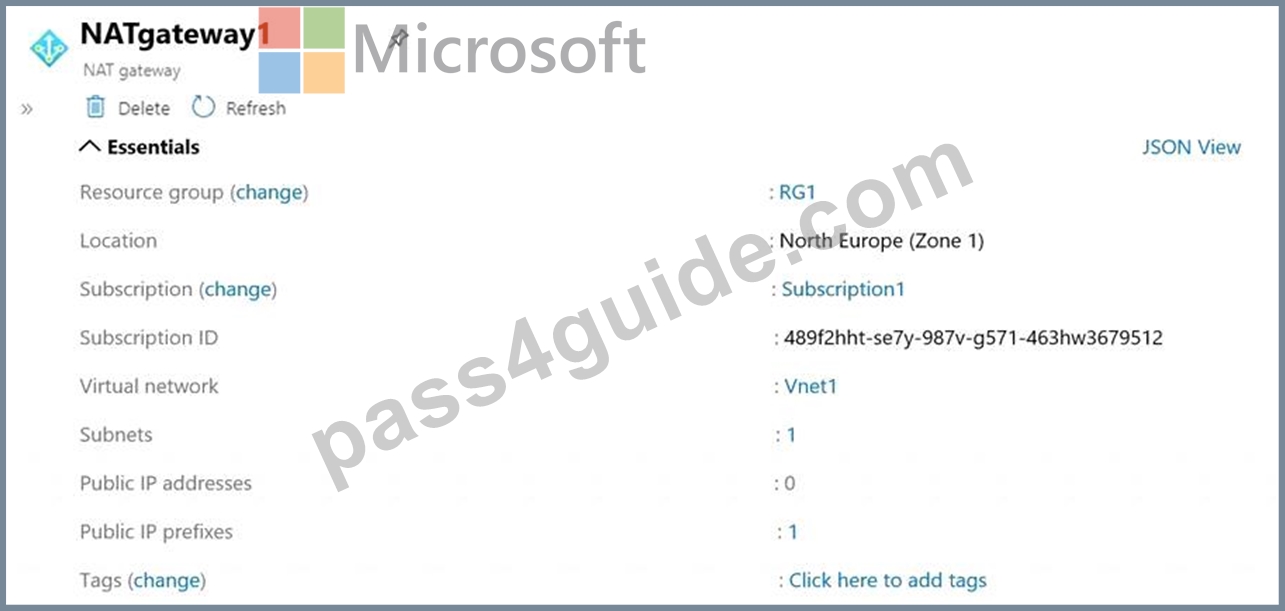
You have the virtual machine shown in the VM1 exhibit.
Subnet1 is configured as shown in the Subnet1 exhibit.
For each of the following statements, select Yes of the statement is true. Otherwise, select No.
NOTE: Each correct selection is worth one point.
Answer:
Explanation:
Explanation
Graphical user interface, text, application Description automatically generated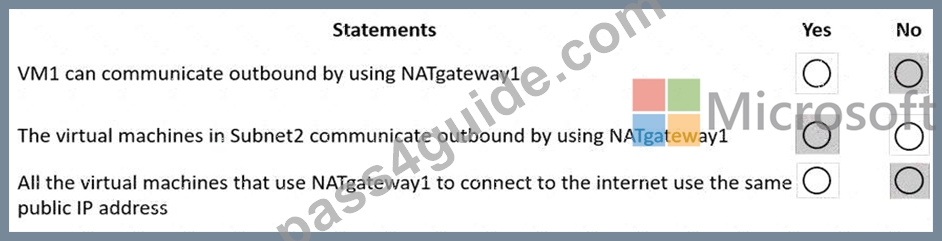
Box 1: No
VM1 is in Zone2 whereas the NAT Gateway is in Zone1. The VM would need to be in the same zone as the NAT Gateway to be able to use it. Therefore, VM1 cannot use the NAT gateway.
Box 2: Yes
NATgateway1 is configured in the settings for Subnet2.
Box 3: No
The NAT gateway does not have a single public IP address, it has an IP prefix which means more than one IP address. The VMs the use the NAT Gateway can use different public IP addresses contained within the IP prefix.
Reference:
https://docs.microsoft.com/en-us/azure/virtual-network/nat-gateway/nat-gateway-resource
NEW QUESTION # 17
Note: This question is part of a series of questions that present the same scenario. Each question in the series contains a unique solution that might meet the stated goals. Some question sets might have more than one correct solution, while others might not have a correct solution.
After you answer a question in this section, you will NOT be able to return to it. As a result, these questions will not appear in the review screen.
You have an Azure subscription that contains the following resources:
* A virtual network named Vnet1
* A subnet named Subnet1 in Vnet1
* A virtual machine named VM1 that connects to Subnet1
* Three storage accounts named storage1, storage2, and storage3
You need to ensure that VM1 can access storage1. VM1 must be prevented from accessing any other storage accounts.
Solution: You create a network security group (NSG) and associate the NSG to Subnet1.
Does this meet the goal?
- A. Yes
- B. No
Answer: A
NEW QUESTION # 18
Your on-premises network contains a VPN device.
You have an Azure subscription that contains a virtual network and a virtual network gateway.
You need to create a Site-to-Site VPN connection that has a custom cryptographic policy.
How should you complete the PowerShell script? To answer, select the appropriate options in the answer area.
NOTE: Each correct selection is worth one point.
Answer:
Explanation:
NEW QUESTION # 19
You have an Azure firewall shown in the following exhibit.
Use the drop-down menus to select the answer choice that completes each statement based on the information presented in the graphic.
NOTE: Each correct selection is worth one point.
Answer:
Explanation: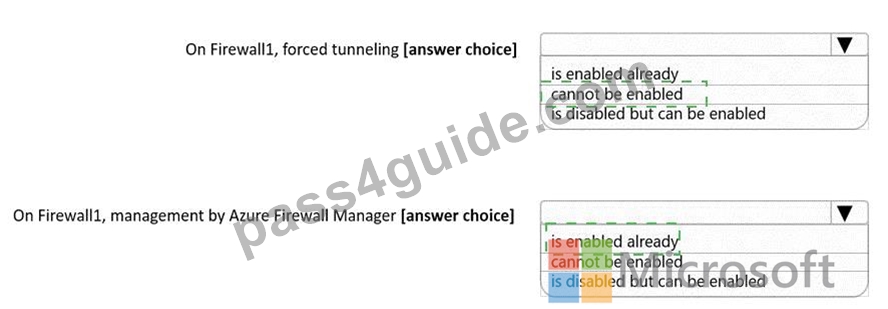
Explanation
Graphical user interface, text, application, email Description automatically generated
Box 1:
If forced tunneling was enabled, the Firewall Subnet would be named AzureFirewallManagementSubnet.
Forced tunneling can only be enabled during the creation of the firewall. It cannot be enabled after the firewall has been deployed.
Box 2:
The "Visit Azure Firewall Manager to configure and manage this firewall" link in the exhibit shows that the firewall is managed by Azure Firewall Manager.
NEW QUESTION # 20
You have an Azure application gateway named AGW1 that has a routing rule named Rule1. Rule 1 directs traffic for http://www.contoso.com to a backend pool named Pool1. Pool1 targets an Azure virtual machine scale set named VMSS1.
You deploy another virtual machine scale set named VMSS2.
You need to configure AGW1 to direct all traffic for http://www.adatum.com to VMSS2.
The solution must ensure that requests to http://www.contoso.com continue to be directed to Pool1.
Which three actions should you perform? Each correct answer presents part of the solution.
NOTE: Each correct selection is worth one point.
- A. Add a rule.
- B. Modify an HTTP setting.
- C. Add a backend pool.
- D. Add a listener.
- E. Add an HTTP setting.
Answer: A,C,D
Explanation:
Reference:
https://docs.microsoft.com/en-us/azure/application-gateway/configuration-overview
NEW QUESTION # 21
You have an Azure Front Door instance that provides access to a web app. The web app uses a hostname of www.contoso.com.
You have the routing rules shown in the following table.
Which rule will apply to each incoming request? To answer, select the appropriate options in the answer area.
NOTE: Each correct selection is worth one point
Answer:
Explanation:
Reference:
https://docs.microsoft.com/en-us/azure/frontdoor/front-door-route-matching
NEW QUESTION # 22
Note: This question is part of a series of questions that present the same scenario. Each question in the series contains a unique solution that might meet the stated goals. Some question sets might have more than one correct solution, while others might not have a correct solution.
After you answer a question in this section, you will NOT be able to return to it. As a result, these questions will not appear in the review screen.
You have an Azure application gateway that has Azure Web Application Firewall (WAF) enabled.
You configure the application gateway to direct traffic to the URL of the application gateway.
You attempt to access the URL and receive an HTTP 403 error. You view the diagnostics log and discover the following error.
You need to ensure that the URL is accessible through the application gateway.
Solution: You create a WAF policy exclusion request headers that contain 137.135.10.24.
Does this meet the goat?
- A. No
- B. Yes
Answer: A
NEW QUESTION # 23
You have an Azure subscription that contains an app named Appl. App1 is hosted on the Azure App Service instances shown in the following table.
You need to implement Azure Traffic Manager to meet the following requirements:
* App1 traffic must be assigned equally to each App Service instance in each Azure region.
* App1 traffic from North Europe must be routed to the Appl instances in the North Europe region.
* App1 traffic from North America must be routed to the Appl instances in the East US Azure region.
Answer:
Explanation:
Explanation
NEW QUESTION # 24
You create NSG10 and NSG11 to meet the network security requirements.
For each of the following statements, select Yes it the statement is true. Otherwise, select No.
NOTE: Each correct selection is worth one point.
Answer:
Explanation:
NEW QUESTION # 25
You are implementing the Virtual network requirements for Vnet6.
What is the minimum number of subnets and service endpoints you should create? To answer, select the appropriate options in the answer area.
NOTE: Each correct selection is worth one point.
Answer:
Explanation:
NEW QUESTION # 26
You have the Azure virtual networks shown in the following table.
You have the Azure resources shown in the following table.
You need to check latency between the resources by using connection monitors in Azure Network Watcher.
What is the minimum number of connection monitors that you must create?
- A. 0
- B. 1
- C. 2
- D. 3
- E. 4
Answer: A
NEW QUESTION # 27
You have the network security groups (NSGs) shown in the following table.
In NSG1, you create inbound rules as shown in the following table.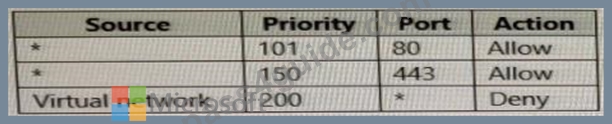
You have the Azure virtual machines shown in the following table.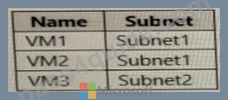
NSG2 has only the default rules configured.
For each of the following statements, select Yes if the statement is true. Otherwise, select No.
NOTE: Each correct selection is worth one point.
Answer:
Explanation:
Explanation
NO, NO, YES
1. VM3 can connect to port 8080 on VM1 : false, UserRule_DenyVirtualNetworkInbound
2. VM1 and VM2 can connect on port 9090: false, UserRule_DenyVirtualNetworkInbound
3. VM1 can connect to VM3 on port 9090: true
NEW QUESTION # 28
You are planning an Azure solution that will contain the following types of resources in a single Azure region:
Virtual machine
Azure App Service
Virtual Network gateway
Azure SQL Managed Instance
App Service and SQL Managed Instance will be delegated to create resources in virtual networks.
You need to identify how many virtual networks and subnets are required for the solution. The solution must minimize costs to transfer data between virtual networks.
What should you identify? To answer, select the appropriate options in the answer area.
NOTE: Each correct selection is worth one point.
Answer:
Explanation: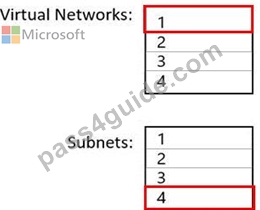
Reference:
https://docs.microsoft.com/en-us/azure/virtual-network/virtual-network-for-azure-services#services-that-can-be-deployed-into-a-virtual-network
NEW QUESTION # 29
You need to connect an on-premises network and an Azure environment. The solution must use ExpressRoute and support failing over to a Site-to-Site VPN connection if there is an ExpressRoute failure.
What should you configure? To answer, select the appropriate options in the answer area.
NOTE: Each correct selection is worth one point.
Answer:
Explanation: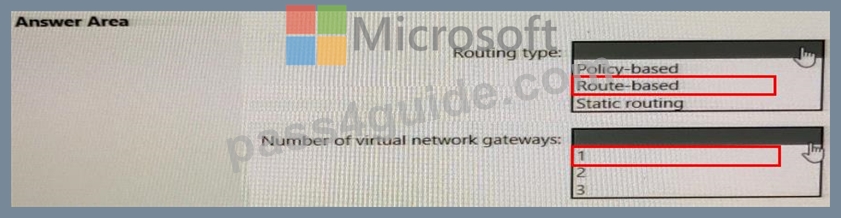
Reference:
https://docs.microsoft.com/en-us/azure/expressroute/expressroute-howto-coexist-resource-manager
NEW QUESTION # 30
You have two Azure subscriptions named Subscnption1 and Subscription2. Subscription1 contains a virtual network named Vnet1. Vnet1 contains an application server. Subscription2 contains a virtual network named Vnet2.
You need to provide the virtual machines in Vnet2 with access to the application server in Vnet1 by using a private endpoint.
Which four actions should you perform in sequence? To answer, move the appropriate actions from the list of actions to the answer area and arrange them in the correct order.
Answer:
Explanation:
1 - In Subscription1, accept the private endpoint connection request.
2 - Enable virtual network peering between Vnet1 and Vnet2.
3 - Deploy an Azure Standard Load Balancer in fron of the application server.
4 - In Subscription1, create a private link service...
NEW QUESTION # 31
Your on-premises network contains a VPN device.
You have an Azure subscription that contains a virtual network and a virtual network gateway.
You need to create a Site-to-Site VPN connection that has a custom cryptographic policy.
How should you complete the PowerShell script? To answer, select the appropriate options in the answer area.
NOTE: Each correct selection is worth one point.
Answer:
Explanation: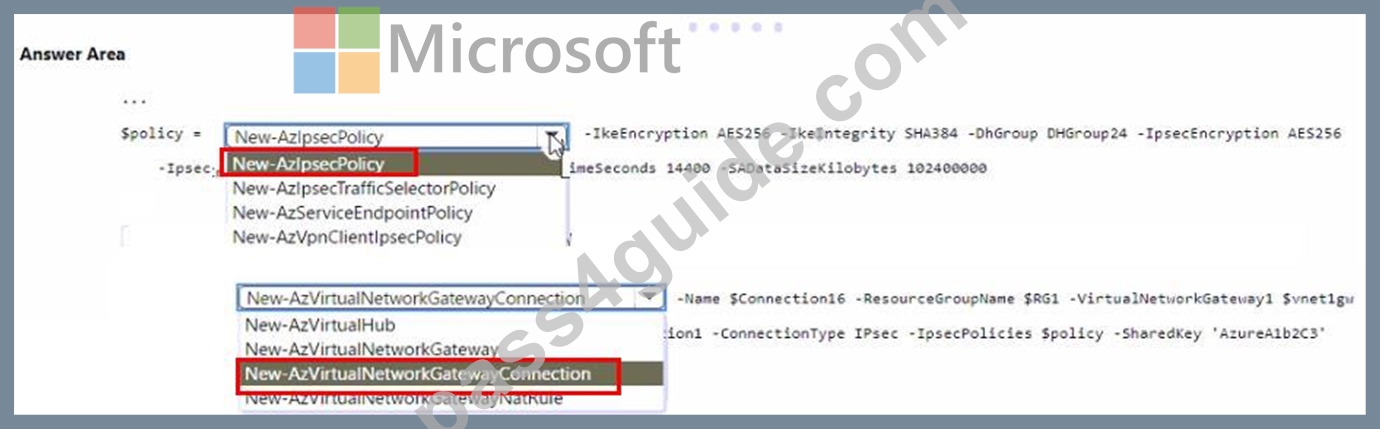
NEW QUESTION # 32
You have 10 Azure App Service instances. Each instance hosts the same web app. Each instance is in a different Azure region.
You need to configure Azure Traffic Manager to direct users to the instance that has the lowest latency.
Which routing method should you use?
- A. weighted
- B. geographic
- C. priority
- D. performance
Answer: C
NEW QUESTION # 33
You have the Azure environment shown in the exhibit.
You have virtual network peering between Vnet1 and Vnet2. You have virtual network peering between Vnet4 and Vnet5. The virtual network peering is configured as shown in the following table.
For each of the following statements, select Yes if the statement is true. Otherwise, select No.
NOTE: Each correct selection is worth one point.
Answer:
Explanation:
NEW QUESTION # 34
You are implementing the virtual network requirements for VM Analyze.
What should you include in a custom route that is linked to Subnet2? To answer, select the appropriate options in the answer area.
NOTE: Each correct selection is worth one point.
Answer:
Explanation: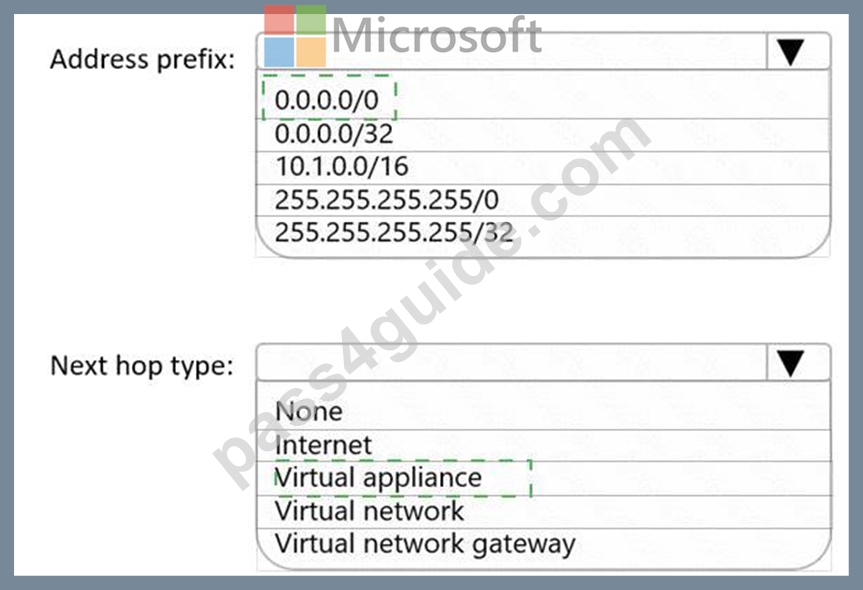
Explanation
Graphical user interface, text, application Description automatically generated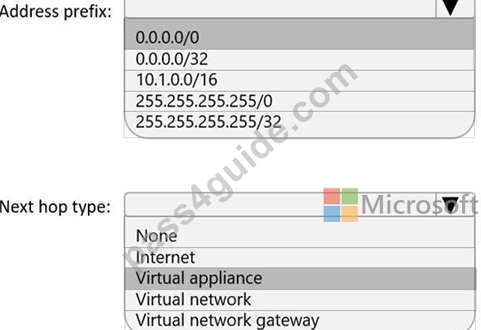
Reference:
https://docs.microsoft.com/en-us/azure/virtual-network/virtual-networks-udr-overview
NEW QUESTION # 35
You have the Azure App Service app shown in the App Service exhibit.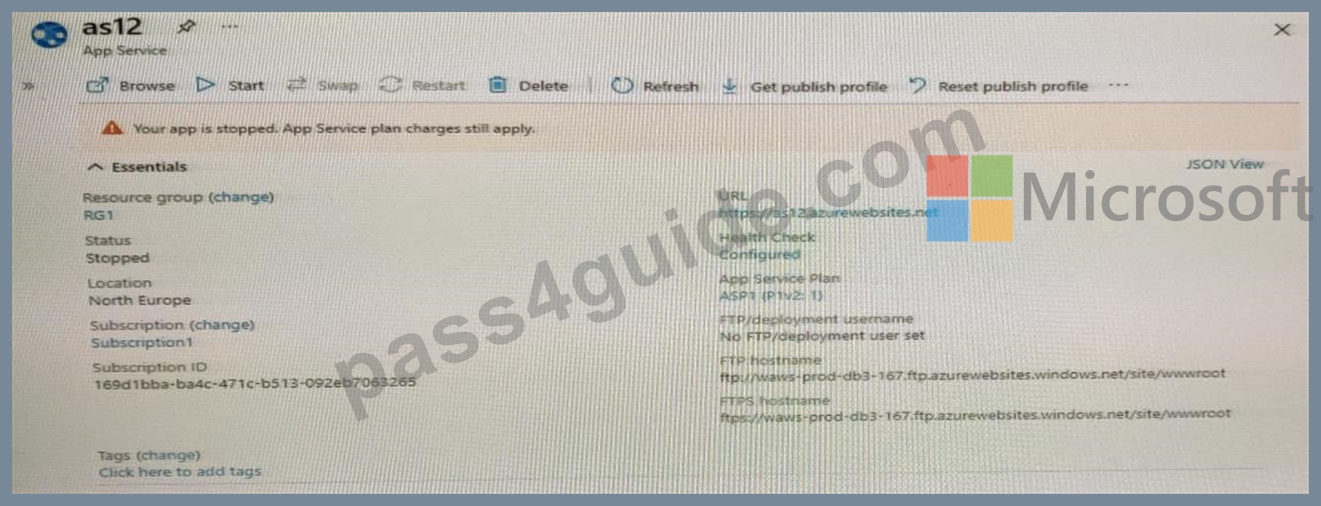
The VNet Integration settings for as12 are configured as shown in the Vnet Integration exhibit.
The Private Endpoint connections settings for as12 are configured as shown in the Private Endpoint connections exhibit.
For each of the following statements, select Yes if the statement is true. Otherwise, select No.
NOTE: Each correct selection is worth one point.
Answer:
Explanation:
Reference:
https://docs.microsoft.com/en-us/azure/app-service/web-sites-integrate-with-vnet
NEW QUESTION # 36
......
Microsoft AZ-700 exam is designed for professionals who want to validate their skills and knowledge in designing and implementing Microsoft Azure networking solutions. Designing and Implementing Microsoft Azure Networking Solutions certification exam is ideal for architects, engineers, and consultants who work with Azure networking solutions on a regular basis. AZ-700 exam measures the ability of candidates to design and implement secure, scalable, and highly available networking solutions using Azure services.
Pass Guaranteed Quiz 2024 Realistic Verified Free Microsoft: https://vcepractice.pass4guide.com/AZ-700-dumps-questions.html