


2025 Updated Verified NSE7_EFW-7.2 dumps Q&As - Pass Guarantee or Full Refund
NSE7_EFW-7.2 PDF Questions and Testing Engine With 58 Questions
NEW QUESTION # 23
Exhibit.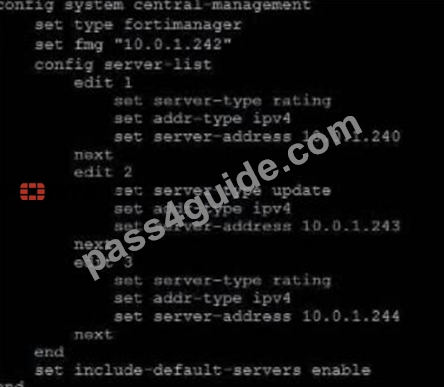
Refer to exhibit, which shows a central management configuration
Which server will FortiGate choose for web filler rating requests if 10.0.1.240 is experiencing an outage?
- A. Public FortiGuard servers
- B. 10.0.1.242
- C. 10.0.1.243
- D. 10.0.1.244
Answer: D
Explanation:
In the event of an outage at 10.0.1.240, the FortiGate will choose the next server in the sequence for web filter rating requests, which is 10.0.1.244 according to the configuration shown in the exhibit. This is because the server list is ordered by priority, and the server with the lowest priority number is chosen first. If that server is unavailable, the next server with the next lowest priority number is chosen, and so on. The public FortiGuard servers are only used if the include-default-servers option is enabled and all the custom servers are unavailable. Reference := Fortinet Enterprise Firewall Study Guide for FortiOS 7.2, page 132.
NEW QUESTION # 24
Exhibit.
Refer to the exhibit, which contains the partial ADVPN configuration of a spoke.
Which two parameters must you configure on the corresponding single hub? (Choose two.)
- A. Set ike-version 2
- B. Set auto-discovery-forwarder enable
- C. Set auto-discovery-receiver enable
- D. Set auto-discovery-sender enable
Answer: A,D
Explanation:
For an ADVPN spoke configuration shown, the corresponding hub must have auto-discovery-sender enabled to send shortcut advertisement messages to the spokes. Also, the hub would need to have auto-discovery- forwarder enabled if it is to forward on those shortcut advertisements to other spokes. This allows the hub to inform all spokes about the best path to reach each other. The ike-version does not need to be reconfigured on the hub if it's already set to version 2 and auto-discovery-receiver is not necessary on the hub because it's the one sending the advertisements, not receiving.
References:
* FortiOS Handbook - ADVPN
NEW QUESTION # 25
Which statement about network processor (NP) offloading is true?
- A. The NP provides IPS signature matching
- B. For TCP traffic FortiGate CPU offloads the first packets of SYN/ACK and ACK of the three-way handshake to NP
- C. You can disable the NP for each firewall policy using the command np-acceleration st to loose.
- D. The NP checks the session key or IPSec SA
Answer: B
Explanation:
Option A is correct because the FortiGate CPU offloads the first packets of TCP sessions to the NP for faster connection establishment and reduced CPU load1. This feature is called TCP offloading and it is enabled by default on FortiGate models with NP6 or higher2.
Option B is incorrect because the NP does not provide IPS signature matching. The NP only handles the packet forwarding and encryption/decryption functions, while the IPS signature matching is performed by the content processor (CP) or the CPU3.
Option C is incorrect because the command to disable the NP for each firewall policy is set np-acceleration disable, not set np-acceleration st to loose4. This command can be used to prevent certain traffic types from being offloaded to the NP, such as multicast, broadcast, or non-IP packets5.
Option D is incorrect because the NP does not check the session key or IPSec SA. The NP only offloads the IPSec encryption/decryption and tunneling functions, while the session key and IPSec SA are managed by the CPU. Reference: =
1: TCP offloading
2: Network processors (NP6, NP6XLite, NP6Lite, and NP4)
3: Content processors (CP9, CP9XLite, CP9Lite)
4: Disabling NP offloading for firewall policies
5: NP hardware acceleration alters packet flow
6: IPSec VPN concepts
NEW QUESTION # 26
You want to configure faster failure detection for BGP
Which parameter should you enable on both connected FortiGate devices?
- A. Ebgp-enforce-multihop
- B. Graceful-restart
- C. Distribute-list-in
- D. bfd
Answer: D
Explanation:
BFD (Bidirectional Forwarding Detection) is a protocol that provides fast failure detection for BGP by sending periodic messages to verify the connectivity between two peers1. BFD can be enabled on both connected FortiGate devices by using the command set bfd enable under the BGP configuration2. Reference: = Technical Tip : FortiGate BFD implementation and examples ..., Configure BGP | FortiGate / FortiOS 7.0.2 - Fortinet Documentation
NEW QUESTION # 27
Refer to the exhibit, which contains information about an IPsec VPN tunnel.
What two conclusions can you draw from the command output? (Choose two.)
- A. The IKE version is 2.
- B. Dead peer detection is set to enable.
- C. Both IPsec SAs are loaded on the kernel.
- D. Forward error correction in phase 2 is set to enable.
Answer: A,C
Explanation:
From the command output shown in the exhibit:
B: The IKE version is 2: This can be deduced from the presence of 'ver=2' in the output, which indicates that IKEv2 is being used.
C: Both IPsec SAs are loaded on the kernel: This is indicated by the line 'npu flags=0x0/0', suggesting that no offload to NPU is occurring, and hence, both Security Associations are loaded onto the kernel for processing.
Fortinet documentation specifies that the version of IKE (Internet Key Exchange) used and the loading of IPsec Security Associations can be verified through the diagnostic commands related to VPN tunnels.
NEW QUESTION # 28
After enabling IPS you receive feedback about traffic being dropped.
What could be the reason?
- A. Np-accel-mode is set to enable
- B. IPS is configured to monitor
- C. Traffic-submit is set to disable
- D. Fail-open is set to disable
Answer: D
Explanation:
Fail-open is a feature that allows traffic to pass through the IPS sensor without inspection when the sensor fails or is overloaded. If fail-open is set to disable, traffic will be dropped in such scenarios1. References:
= IPS | FortiGate / FortiOS 7.2.3 - Fortinet Documentation
When IPS (Intrusion Prevention System) is configured, iffail-openis set to disable, it means that if the IPS engine fails, traffic will not be allowed to pass through, which can result in traffic being dropped (D). This is in contrast to a fail-open setting, which would allow traffic to bypass the IPS engine if it is not operational.
NEW QUESTION # 29
Which ADVPN configuration must be configured using a script on fortiManager, when using VPN Manager to manage fortiGate VPN tunnels?
- A. Configure IP addresses on IPsec virtual interlaces
- B. Enable AD-VPN in IPsec phase 1
- C. Disable add-route on hub
- D. Set protected network to all
Answer: B
Explanation:
To enable AD-VPN, you need to edit an SD-WAN overlay template and enable the Auto-Discovery VPN toggle. This will automatically add the required settings to the IPsec template and the BGP template. You cannot enable AD-VPN directly in the IPsec phase 1 settings using VPN Manager. References := ADVPN | FortiManager 7.2.0 - Fortinet Documentation
NEW QUESTION # 30
Refer to the exhibit, which shows the output of a BGP summary.
What two conclusions can you draw from this BGP summary? (Choose two.)
- A. The BGP session with peer 10. 127. 0. 75 is established.
- B. The neighbors displayed are linked to a local router with the neighbor-range set to a value of 4.
- C. The router 100. 64. 3. 1 has the parameter bfd set to enable.
- D. External BGP (EBGP) exchanges routing information.
Answer: A,D
Explanation:
The output of the BGP (Border Gateway Protocol) summary shows details about the BGP neighbors of a router, their Autonomous System (AS) numbers, the state of the BGP session, and other metrics like messages received and sent.
From the BGP summary provided:
A).External BGP (EBGP) exchanges routing information.This conclusion can be inferred because the AS numbers for the neighbors are different from the local AS number (65117), which suggests that these are external connections.
B).The BGP session with peer 10.127.0.75 is established.This is indicated by the state/prefix received column showing a numeric value (1), which typically means that the session is established and a number of prefixes has been received.
C).The router 100.64.3.1 has the parameter bfd set to enable.This cannot be concluded directly from the summary without additional context or commands specifically showing BFD (Bidirectional Forwarding Detection) configuration.
D).The neighbors displayed are linked to a local router with the neighbor-range set to a value of 4.The neighbor-range concept does not apply here; the value 4 in the 'V' column stands for the BGP version number, which is typically 4.
NEW QUESTION # 31
Which two statements about IKE version 2 fragmentation are true? (Choose two.)
- A. The maximum number of IKE version 2 fragments is 128.
- B. Only some IKE version 2 packets are considered fragmentable.
- C. The reassembly timeout default value is 30 seconds.
- D. It is performed at the IP layer.
Answer: A,B
Explanation:
In IKE version 2, not all packets are fragmentable. Only certain messages within the IKE negotiation process can be fragmented. Additionally, there is a limit to the number of fragments that IKE version 2 can handle, which is 128. This is specified in the Fortinet documentation and ensures that the IKE negotiation process can proceed even in networks that have issues with large packets. The reassembly timeout and the layer at which fragmentation occurs are not specified in this context within Fortinet documentation.
NEW QUESTION # 32
Exhibit.
Refer to the exhibit, which shows information about an OSPF interlace
What two conclusions can you draw from this command output? (Choose two.)
- A. The OSPF routers are in the area ID of 0.0.0.1.
- B. The interfaces of the OSPF routers match the MTU value that is configured as 1500.
- C. The port3 network has more man one OSPF router
- D. NGFW-1 is the designated router
Answer: B,C
Explanation:
From the OSPF interface command output, we can conclude that the port3 network has more than one OSPF router because the Neighbor Count is 2, indicating the presence of another OSPF router besides NGFW-1.
Additionally, we can deduce that the interfaces of the OSPF routers match the MTU value configured as
1500, which is necessary for OSPF neighbors to form adjacencies. The MTU mismatch would prevent OSPF from forming a neighbor relationship.
References:
* Fortinet FortiOS Handbook: OSPF Configuration
NEW QUESTION # 33
Refer to the exhibit, which shows config system central-management information.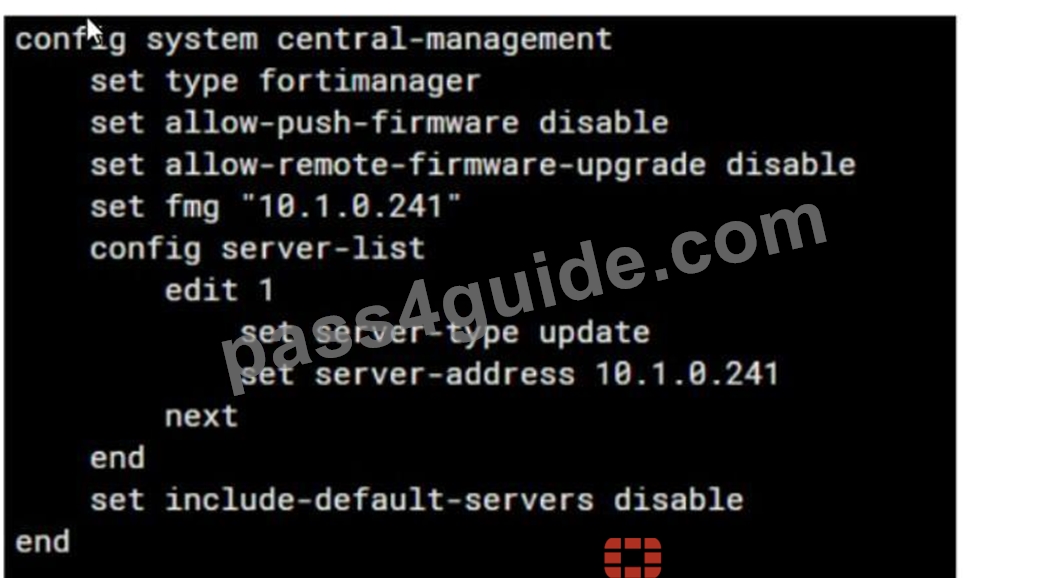
Which setting must you configure for the web filtering feature to function?
- A. Set update-server-location to automatic.
- B. Configure securewf.fortiguard. net on the default servers.
- C. Add server. fortiguard. net to the server list.
- D. Configure server-type with the rating option.
Answer: C
Explanation:
For the web filtering feature to function effectively, the FortiGate device needs to have a server configured for rating services. The rating option in the server-type setting specifies that the server is used for URL rating lookup, which is essential for web filtering. The displayed configuration does not list any FortiGuard web filtering servers, which would be necessary for web filtering. The setting set include-default-servers disable indicates that the default FortiGuard servers are not being used, and hence, a specific server for web filtering (like securewf.fortiguard.net) needs to be configured.
NEW QUESTION # 34
Exhibit.
Refer to the exhibit, which contains a CLI script configuration on fortiManager. An administrator configured the CLI script on FortiManager rut the script tailed to apply any changes to the managed device after being executed.
What are two reasons why the script did not make any changes to the managed device? (Choose two)
- A. Static routes can be added using only TCI scripts.
- B. Incomplete commands can cause CLI scripts to fail.
- C. CLI scripts must start with #!.
- D. The commands that start with the # sign did not run.
Answer: B,D
Explanation:
The commands that start with the # sign did not run because they are treated as comments in the CLI script.
Incomplete commands can cause CLI scripts to fail because they are not recognized by the FortiGate device.
The other options are incorrect because static routes can be added using CLI or GUI, and CLI scripts do not need to start with #!. References := Configuring custom scripts | FortiManager 7.2.0 - Fortinet Documentation, section "CLI script syntax".
NEW QUESTION # 35
Winch two statements about ADVPN are true? (Choose two)
- A. Routing is configured by enabling add-advpn-route
- B. lt supports NAI for on-demand tunnels
- C. Spoke to-spoke traffic never goes through the hub
- D. auto-discovery receiver must be set to enable on the Spokes.
Answer: B,D
Explanation:
ADVPN (Auto Discovery VPN) is a feature that allows to dynamically establish direct tunnels (called shortcuts) between the spokes of a traditional Hub and Spoke architecture. The auto-discovery receiver must be set to enable on the spokes to allow them to receive NHRP messages from the hub and other spokes. NHRP (Next Hop Resolution Protocol) is used for on-demand tunnels, which are established when there is traffic between spokes. Routing is configured by enabling add-nhrp-route, not add-advpn-route. Reference := ADVPN | FortiGate / FortiOS 7.2.0 | Fortinet Document Library, Technical Tip: Fortinet Auto Discovery VPN (ADVPN)
NEW QUESTION # 36
Refer to the exhibit, which shows an SSL certification inspection configuration.
Which action does FortiGate take if the server name indication (SNI) does not match either the common name (CN) or any of the subject alternative names (SAN) in the server certificate?
- A. FortiGate closes the connection because this represents an invalid SSL/TLS configuration
- B. FortiGate uses the SNI from the user's web browser.
- C. FortiGate uses the CN information from the Subject field in the server certificate
- D. FortiGate uses the first entry listed in the SAN field in the server certificate
Answer: A
NEW QUESTION # 37
You created a VPN community using VPN Manager on FortiManager. You also added gateways to the VPN community. Now you are trying to create firewall policies to permit traffic over the tunnel however, the VPN interfaces do not appear as available options.
- A. Refresh the device status using the Device Manager so that FortiGate populates the IPSec interfaces
- B. install the VPN community and gateway configuration on the fortiGate devices so that the VPN interfaces appear on the Policy Objects on fortiManager.
- C. Create interface mappings for the IPsec VPN interfaces before you use them in a policy.
- D. Configure the phase 1 settings in the VPN community that you didnt initially configure. FortiGate automatically generates the interfaces after you configure the required settings
Answer: B
Explanation:
To use the VPN interfaces in a policy, you need to install the VPN community and gateway configuration on the FortiGate devices first. This will create the VPN interfaces on the FortiGate and sync them with FortiManager. Reference:
Creating IPsec VPN communities
VPN | FortiGate / FortiOS 7.2.0
NEW QUESTION # 38
Which, three conditions are required for two FortiGate devices to form an OSPF adjacency? (Choose three.)
- A. OSPF router IDs are unique
- B. OSPF interface network types match
- C. OSPF interface priority settings are unique
- D. Authentication settings match
- E. OSPF link costs match
Answer: A,B,D
Explanation:
Option A is correct because the OSPF interface network types determine how the routers form adjacencies and exchange LSAs on a network segment. The network types must match for the routers to become neighbors1.
Option B is correct because the OSPF router IDs are used to identify each router in the OSPF domain and to establish adjacencies. The router IDs must be unique for the routers to become neighbors2.
Option E is correct because the authentication settings control how the routers authenticate each other before exchanging OSPF packets. The authentication settings must match for the routers to become neighbors3.
Option C is incorrect because the OSPF interface priority settings are used to elect the designated router (DR) and the backup designated router (BDR) on a broadcast or non-broadcast multi-access network. The priority settings do not have to be unique for the routers to become neighbors, but they affect the DR/BDR election process4.
Option D is incorrect because the OSPF link costs are used to calculate the shortest path to a destination network based on the bandwidth of the links. The link costs do not have to match for the routers to become neighbors, but they affect the routing decisions5. Reference: =
1: OSPF network types
2: OSPF router ID
3: OSPF authentication
4: OSPF interface priority
5: OSPF link cost
NEW QUESTION # 39
Refer to the exhibit, which shows an error in system fortiguard configuration.
What is the reason you cannot set the protocol to udp in config system fortiguard?
- A. fortiguard-anycast is set to enable.
- B. udp is not a protocol option.
- C. You do not have the corresponding write access.
- D. FortiManager provides FortiGuard.
Answer: A
Explanation:
The reason for the command failure when trying to set the protocol to UDP in the config system fortiguard is likely that UDP is not a protocol option in this context. The command syntax might be incorrect or the option to set a protocol for FortiGuard updates might not exist in this manner. So the correct answer is D. udp is not a protocol option.
NEW QUESTION # 40
Refer to the exhibit, which shows two configured FortiGate devices and peering over FGSP.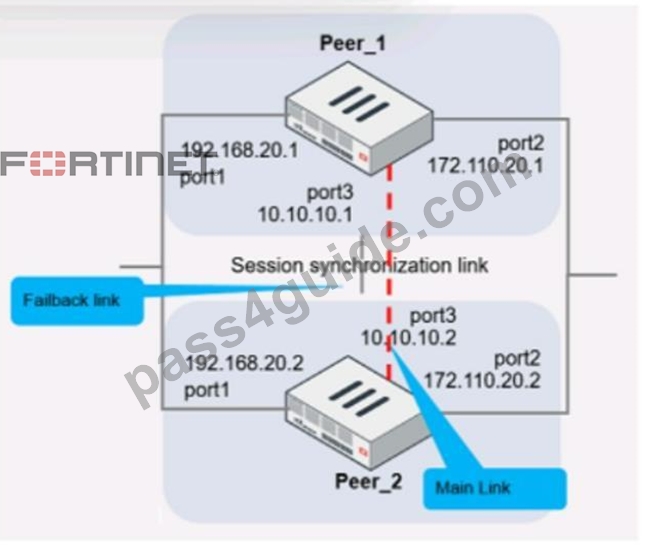
The main link directly connects the two FortiGate devices and is configured using the set session-syn-dev <interface> command.
What is the primary reason to configure the main link?
- A. To have both sessions and configuration synchronization in layer 3
- B. To have both sessions and configuration synchronization in layer 2
- C. To load balance both sessions and configuration synchronization between layer 2 and 3
- D. To have only configuration synchronization in layer 3
Answer: A
Explanation:
The primary purpose of configuring a main link between the devices is to synchronize session information so that if one unit fails, the other can continue processing traffic without dropping active sessions.
A: To have both sessions and configuration synchronization in layer 2.This is incorrect because FGSP is used for session synchronization, not configuration synchronization.
B: To load balance both sessions and configuration synchronization between layer 2 and 3.FGSP does not perform load balancing and is not used for configuration synchronization.
C: To have only configuration synchronization in layer 3.The main link is not used solely for configuration synchronization.
D: To have both sessions and configuration synchronization in layer 3.The main link in an FGSP setup is indeed used to synchronize session information across the devices, and it operates at layer 3 since it uses IP addresses to establish the peering.
NEW QUESTION # 41
Exhibit.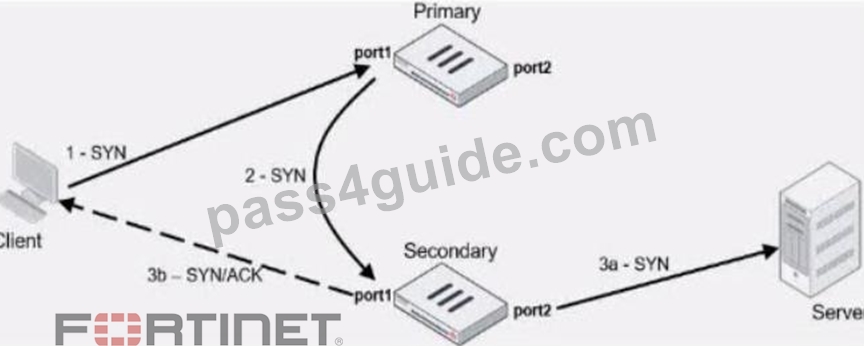
Refer to the exhibit, which contains an active-active toad balancing scenario.
During the traffic flow the primary FortiGate forwards the SYN packet to the secondary FortiGate.
What is the destination MAC address or addresses when packets are forwarded from the primary FortiGate to the secondary FortiGate?
- A. Secondary physical MAC port1
- B. Secondary virtual MAC port1
- C. Secondary physical MAC port2 then virtual MAC port2
- D. Secondary virtual MAC port1 then physical MAC port1
Answer: B
Explanation:
The destination MAC address when packets are forwarded from the primary FortiGate to the secondary FortiGate is the secondary virtual MAC port1. This is because the primary FortiGate uses the virtual MAC address of the secondary FortiGate as the destination MAC address for the SYN packet. The virtual MAC address is derived from the HA group ID and the interface ID, and it is unique for each HA cluster member and interface. The virtual MAC address enables the secondary FortiGate to receive the SYN packet without ARP resolution. Reference: You can find more information about active-active load balancing and virtual MAC address in the following Fortinet Enterprise Firewall 7.2 documents:
Virtual server load balance
NP session offloading in HA active-active configuration
Technical Tip: How to enable TCP load balance in HA with active-active mode
NEW QUESTION # 42
......
Exam Engine for NSE7_EFW-7.2 Exam Free Demo & 365 Day Updates: https://vcepractice.pass4guide.com/NSE7_EFW-7.2-dumps-questions.html