


Online NetSec-Analyst Test Brain Dump Question and Test Engine
Real Palo Alto Networks NetSec-Analyst Exam Dumps with Correct 373 Questions and Answers
Palo Alto Networks NetSec-Analyst Exam Syllabus Topics:
| Topic | Details |
|---|---|
| Topic 1 |
|
| Topic 2 |
|
| Topic 3 |
|
| Topic 4 |
|
NEW QUESTION # 166
Which two statements are true for the DNS security service introduced in PAN-OS version 10.0?
- A. IT is automatically enabled and configured.
- B. IT eliminates the need for dynamic DNS updates.
- C. It removes the 100K limit for DNS entries for the downloaded DNS updates.
- D. It functions like PAN-DB and requires activation through the app portal.
Answer: C,D
NEW QUESTION # 167
A large enterprise with a global presence is deploying Palo Alto Networks firewalls across hundreds of branch offices. The security team needs to ensure consistent security policies, network configurations, and software versions across all devices, while also allowing localized administrative control for specific regions without compromising central oversight. They are currently struggling with policy sprawl and inconsistent configurations due to a lack of a standardized management approach.
- A. Deploy a single, monolithic firewall and route all branch traffic through it to simplify policy management.
- B. Manage each firewall individually via its web interface and create custom policy sets for each branch based on regional requirements.
- C. Implement Panorama as a centralized management system, utilizing Device Groups to logically organize firewalls and manage shared policies. Then, use Administrative Roles to delegate granular access based on regions.
- D. Use a third-party SIEM solution to monitor firewall configurations and manually correct any discrepancies.
- E. Utilize an Ansible playbook to push configurations to all firewalls, relying solely on automation for consistency.
Answer: C
Explanation:
Option A is the most effective solution. Panorama provides centralized management, enabling consistent policy deployment through Device Groups and shared policy objects. Administrative Roles allow for the delegation of specific management tasks and access rights to regional administrators without giving them full control, thus maintaining central oversight while enabling localized administration. Options B, C, D, and E do not address the core challenges of scalability, consistency, and controlled delegation in a large enterprise environment.
NEW QUESTION # 168
Which three types of entries can be excluded from an external dynamic list (EDL)? (Choose three.)
- A. User-ID
- B. IP addresses
- C. Domains
- D. URLs
- E. Applications
Answer: B,C,D
Explanation:
Three types of entries that can be excluded from an external dynamic list (EDL) are IP addresses, domains, and URLs. An EDL is a text file that is hosted on an external web server and contains a list of objects, such as IP addresses, URLs, domains, International Mobile Equipment Identities (IMEIs), or International Mobile Subscriber Identities (IMSIs) that the firewall can import and use in policy rules. You can exclude entries from an EDL to prevent the firewall from enforcing policy on those entries. For example, you can exclude benign domains that applications use for background traffic from Authentication policy1. To exclude entries from an EDL, you need to:
* Select the EDL on the firewall and click Manual Exceptions.
* Add the entries that you want to exclude in the Manual Exceptions list. The entries must match the type and format of the EDL. For example, if the EDL contains IP addresses, you can only exclude IP addresses.
* Click OK to save the changes. The firewall will not enforce policy on the excluded entries.
References: Exclude Entries from an External Dynamic List, External Dynamic List, Certifications - Palo Alto Networks, Palo Alto Networks Certified Network Security Administrator (PAN-OS 10.0) or Palo Alto Networks Certified Network Security Administrator (PAN-OS 10.0).
NEW QUESTION # 169
Prior to a maintenance-window activity, the administrator would like to make a backup of only the running configuration to an external location.
What command in Device > Setup > Operations would provide the most operationally efficient way to achieve this outcome?
- A. save candidate config
- B. export device state
- C. export named configuration snapshot
- D. save named configuration snapshot
Answer: C
Explanation:
The Revert, Save, and Load operations all work with firewall co nfigurations local to the firewall. The Export operations transfer configurations as XML-formatted files from the firewall to the host running the web interface browser. From your local machine, you can save the files as configuration backups. The Import operations transfer XML configuration files from the host running the web interface browser to the firewall. The XML file can be loaded as the candidate configuration or even be committed to becoming the running configuration. [Palo Alto Networks]
NEW QUESTION # 170
What must be considered with regards to content updates deployed from Panorama?
- A. Panorama can only install up to five content versions of the same type for potential rollback scenarios.
- B. Content update schedulers need to be configured separately per device group.
- C. Panorama can only download one content update at a time for content updates of the same type.
- D. A PAN-OS upgrade resets all scheduler configurations for content updates.
Answer: C
NEW QUESTION # 171
Which feature must be configured to enable a data plane interface to submit DNS queries originated from the firewall on behalf of the control plane?
- A. Admin role profile
- B. Virtual router
- C. DNS proxy
- D. Service route
Answer: D
Explanation:
By default, the firewall uses the management (MGT) interface to access external services, such as DNS servers, external authentication servers, Palo Alto Netw orks services such as soft ware, URL updates, licenses, and AutoFocus. An alternative to using the MGT interface is configuring a data port (a standard interface) to access these services. The path from the interface to th e service on a server is aservice route.
[Palo Alto Networks]
PAN-OS 10 -> Device -> Setup -> Services -> Service Features -> Service Route Configuration
NEW QUESTION # 172
Refer to the exhibit.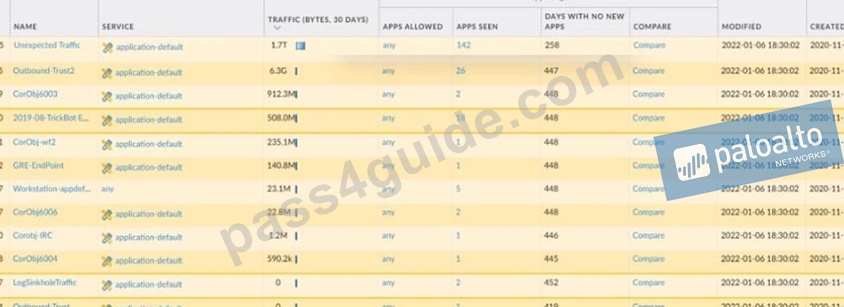
An administrator is updating Security policy to align with best practices.
Which Policy Optimizer feature is shown in the screenshot below?
- A. Rules without App Controls
- B. New App Viewer
- C. Unused Unused Apps
- D. Rule Usage
Answer: D
NEW QUESTION # 173
The firewall sends employees an application block page when they try to access Youtube.
Which Security policy rule is blocking the youtube application?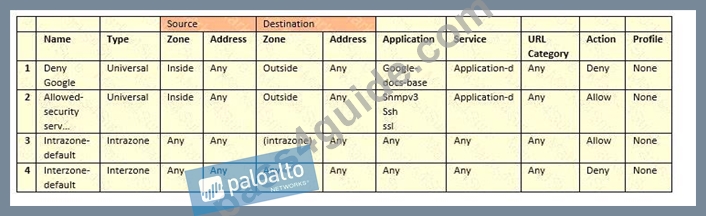
- A. Deny Google
- B. allowed-security services
- C. intrazone-default
- D. interzone-default
Answer: D
NEW QUESTION # 174
Where within the URL Filtering security profile must a user configure the action to prevent credential submissions?
- A. URL Filtering > Categories
- B. URL Filtering > HTTP Header Insertion
- C. URL Filtering > Inline Categorization
- D. URL Filtering > URL Filtering Settings
Answer: A
Explanation:
URL filtering technology protects users from web-based threats by providing granular control over user access and interaction with content on the Internet. You can develop a URL filtering policy that limits access to sites based on URL categories, users, and groups. For example, you can block access to sites known to host malware and prevent end users from entering corporate credentials to sites in certain categories.
NEW QUESTION # 175
A Security Profile can block or allow traffic at which point?
- A. after it is matched to a Security policy rule that allows traffic
- B. on either the data plane or the management plane
- C. after it is matched to a Security policy rule that allows or blocks traffic
- D. before it is matched to a Security policy rule
Answer: A
NEW QUESTION # 176
Which Security policy action will message a user's browser that their web session has been terminated?
- A. Deny
- B. Drop
- C. Reset client
- D. Reset server
Answer: C
Explanation:
Sending a reset only to the client would ensure, for example, internal hosts receive a notification the session was reset and the browser is not left spinning or the application can close the established session while the remote server is left unaware. https://knowledgebase.paloaltonetworks.com/KCSArticleDetail?
id=kA10g000000ClltCAC
NEW QUESTION # 177
In which two Security Profiles can an action equal to the block IP feature be configured? (Choose two.)
- A. URL Filtering
- B. Anti-spyware
- C. Vulnerability Protection
- D. Antivirus
Answer: B,C
Explanation:
https://docs.paloaltonetworks.com/pan-os/9-1/pan-os-web-interface-help/objects/objects-security-profiles
/actions-in-security-profiles
NEW QUESTION # 178
You have been tasked to configure access to a new web server located in the DMZ Based on the diagram what configuration changes are required in the NGFW virtual router to route traffic from the 10 1 1 0/24 network to 192 168 1 0/24?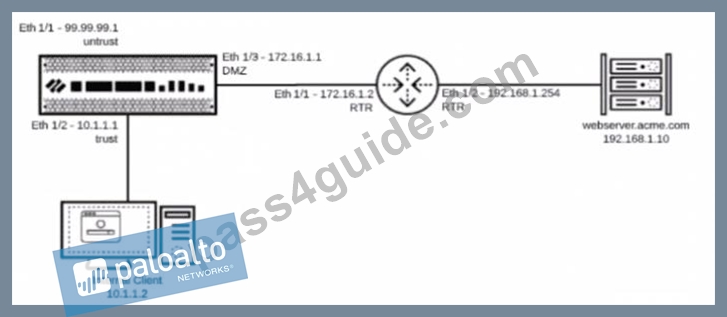
- A. Add a route with the destination of 192 168 1 0/24 using interface Eth 1/2 with a next-hop of 172.16.1.2
- B. Add a route with the destination of 192 168 1 0/24 using interface Eth 1/3 with a next-hop of 192.168.1.254
- C. Add a route with the destination of 192 168 1 0/24 using interface Eth 1/3 with a next-hop of 172.16.1.2
- D. Add a route with the destination of 192 168 1 0/24 using interface Eth 1/3 with a next-hop of 192.168 1.10
Answer: C
NEW QUESTION # 179
Which two compliance frameworks are included with the Premium version of Strata Cloud Manager (SCM)? (Choose two)
- A. National Institute of Standards and Technology (NIST)
- B. Health Insurance Portability and Accountability Act (HIPAA)
- C. Payment Card Industry (PCI)
- D. Center for Internet Security (CIS)
Answer: A,C
Explanation:
Step 1: Understanding Strata Cloud Manager (SCM) Premium
Strata Cloud Manager is a unified management interface for Strata NGFWs, Prisma Access, and other Palo Alto Networks solutions. The Premium version (subscription-based) includes advanced features like:
* AIOps Premium: Predictive analytics, capacity planning, and compliance reporting.
* Compliance Posture Management: Pre-built dashboards and reports for specific regulatory frameworks.
Compliance frameworks in SCM Premium provide visibility into adherence to standards like PCI DSS and NIST, generating actionable insights and audit-ready reports based on firewall configurations, logs, and traffic data.
Reference: Strata Cloud Manager Documentation
"SCM Premium delivers compliance reporting for industry standards, integrating with NGFW telemetry to ensure regulatory alignment." Step 2: Evaluating the Compliance Frameworks Option A: Payment Card Industry (PCI) Analysis: The Payment Card Industry Data Security Standard (PCI DSS) is a mandatory framework for organizations handling cardholder data. SCM Premium includes a PCI DSS Compliance Dashboard that maps NGFW configurations (e.g., security policies, decryption, Threat Prevention) to PCI DSS requirements (e.g., Requirement 1: Firewall protection, Requirement 6: Vulnerability protection). It tracks compliance with controls like network segmentation, encryption, and monitoring, critical for Strata NGFW deployments in payment environments.
Evidence: Palo Alto Networks emphasizes PCI DSS support in SCM Premium for retail, financial, and e- commerce customers, providing pre-configured reports for audits.
Conclusion: Included in SCM Premium.
Reference: Strata Cloud Manager Premium Features Overview
"PCI DSS compliance reporting ensures cardholder data protection with automated insights." Option B: National Institute of Standards and Technology (NIST) Analysis: NIST frameworks, notably the NIST Cybersecurity Framework (CSF) and NIST SP 800-53, are widely adopted for cybersecurity risk management, especially in government and critical infrastructure sectors. SCM Premium offers a NIST Compliance Dashboard, aligning NGFW settings (e.g., App-ID, User- ID, logging) with NIST controls (e.g., Identify, Protect, Detect, Respond, Recover). This is key for Strata customers needing federal compliance or a risk-based approach.
Evidence: Palo Alto Networks documentation highlights NIST CSF and 800-53 mapping in SCM Premium, reflecting its broad applicability.
Conclusion: Included in SCM Premium.
Reference: Strata Cloud Manager AIOps Premium Datasheet
"NIST compliance reporting supports risk management and regulatory adherence." Option C: Center for Internet Security (CIS) Analysis: The CIS Controls and Benchmarks provide practical cybersecurity guidelines (e.g., CIS Controls v8, CIS Benchmarks for OS hardening). While Palo Alto Networks supports CIS principles (e.g., via Best Practice Assessments), SCM Premium documentation does not explicitly list a dedicated CIS Compliance Dashboard. CIS alignment is often manual or supplementary, not a pre-built feature like PCI or NIST.
Evidence: No direct evidence in SCM Premium feature sets confirms CIS as a standard inclusion; it's more commonly referenced in standalone tools like CIS-CAT or Expedition.
Conclusion: Not included in SCM Premium.
Reference: PAN-OS Administrator's Guide (11.1) - Best Practices
"CIS alignment is supported but not a native SCM Premium framework."
Option D: Health Insurance Portability and Accountability Act (HIPAA)
Analysis: HIPAA governs protected health information (PHI) security in healthcare. While Strata NGFWs can enforce HIPAA-compliant policies (e.g., encryption, access control), SCM Premium does not feature a dedicated HIPAA Compliance Dashboard. HIPAA compliance is typically achieved through custom configurations and external audits, not a pre-configured SCM framework.
Evidence: Palo Alto Networks documentation lacks mention of HIPAA as a standard SCM Premium offering, unlike PCI and NIST.
Conclusion: Not included in SCM Premium.
Reference: Strata Cloud Manager Documentation
"HIPAA compliance is supported via NGFW capabilities, not SCM Premium dashboards." Step 3: Why A and B Are Correct A (PCI): Directly addresses a common Strata NGFW use case (payment security) with a tailored dashboard, reflecting SCM Premium's focus on industry-specific compliance.
B (NIST): Provides a flexible, widely adopted framework for cybersecurity, integrated into SCM Premium for broad applicability across sectors.
Exclusion of C and D: CIS and HIPAA, while relevant to NGFW deployments, lack dedicated, pre-built compliance reporting in SCM Premium, making them supplementary rather than core inclusions.
Step 4: Verification Against SCM Premium Features
SCM Premium's compliance posture management explicitly lists PCI DSS and NIST (e.g., CSF, 800-53) as supported frameworks, leveraging NGFW telemetry (e.g., Monitor > Logs > Traffic) and AIOps analytics.
This aligns with Palo Alto Networks' focus on high-demand regulations as of PAN-OS 11.1 and SCM updates through March 08, 2025.
Reference: Strata Cloud Manager Release Notes (March 2025)
"Premium version includes PCI DSS and NIST compliance dashboards for automated reporting." Conclusion The two compliance frameworks included with the Premium version of Strata Cloud Manager are A.
Payment Card Industry (PCI) and B. National Institute of Standards and Technology (NIST). These are verified by SCM Premium's documented capabilities, ensuring Strata NGFW customers can meet regulatory requirements efficiently.
NEW QUESTION # 180
At which point in the app-ID update process can you determine if an existing policy rule is affected by an app- ID update?
- A. after clicking Check New in the Dynamic Update window
- B. after connecting the firewall configuration
- C. after installing the update
- D. after downloading the update
Answer: A
Explanation:
Reference: https://docs.paloaltonetworks.com/pan-os/9-0/pan-os-web-interface-help/device/device- dynamicupdates
NEW QUESTION # 181
Which profile should be used to obtain a verdict regarding analyzed files?
- A. Advanced threat prevention
- B. WildFire analysis
- C. Vulnerability profile
- D. Content-ID
Answer: B
Explanation:
* A profile is a set of rules or settings that defines how the firewall performs a specific function, such as detecting and preventing threats, filtering URLs, or decrypting traffic1.
* There are different types of profiles that can be applied to different types of traffic or scenarios, such as Antivirus, Anti-Spyware, Vulnerability Protection, URL Filtering, File Blocking, Data Filtering, Decryption, or WildFire Analysis1.
* The WildFire Analysis profile is a profile that enables the firewall to submit unknown files or email links to the cloud-based WildFire service for analysis and verdict determination2. WildFire is the industry's most advanced analysis and prevention engine for highly evasive zero-day exploits and malware3. WildFire uses a variety of malware detection techniques, such as static analysis, dynamic analysis, machine learning, and intelligent run-time memory analysis, to identify and protect against unknown threats34.
* The Vulnerability Protection profile is a profile that protects the network from exploits that target known software vulnerabilities. It allows the administrator to configure the actions and log settings for each vulnerability severity level, such as critical, high, medium, low, or informational5.
* Content-ID is not a profile, but a feature of the firewall that performs multiple functions to identify and control applications, users, content, and threats on the network. Content-ID consists of four components: App-ID, User-ID, Content Inspection, and Threat Prevention.
* Advanced Threat Prevention is not a profile, but a term that refers to the comprehensive approach of Palo Alto Networks to prevent sophisticated and unknown threats. Advanced Threat Prevention includes WildFire, but also other products and services, such as DNS Security, Cortex XDR, Cortex XSOAR, and AutoFocus.
Therefore, the profile that should be used to obtain a verdict regarding analyzed files is the WildFire Analysis profile.
References:
1: Security Profiles - Palo Alto Networks 2: WildFire Analysis Profile - Palo Alto Networks 3: WildFire - Palo Alto Networks 4: Advanced Wildfire as an ICAP Alternative | Palo Alto Networks 5: Vulnerability Protection Profile - Palo Alto Networks : [Content-ID - Palo Alto Networks] : [Advanced Threat Prevention - Palo Alto Networks]
NEW QUESTION # 182
A Palo Alto Networks firewall is configured for SSL Forward Proxy decryption. An internal application relies on certificate pinning for security. When users attempt to access this application, they receive certificate warnings, and the application fails to connect. The security team wants to maintain decryption for other traffic but specifically bypass decryption for this application. Which configuration change is the most precise and least impactful to the overall security posture?
- A. Modify the existing decryption profile by adding the application's FQDN to the 'SSL Decryption Exclusion' list under 'SSL Forward Proxy'.
- B. Disable 'Block Session on Untrusted Certificate' in the active decryption profile.
- C. Configure a new Decryption Profile with 'Forward Untrusted Certificates' enabled and apply it only to traffic for this application.
- D. Create a new security policy rule for the application, placing it above existing decryption rules, and set its decryption profile to 'No Decryption'.
- E. Import the application's specific certificate into the firewall's trusted root CA store.
Answer: A
Explanation:
Certificate pinning means the application expects a very specific certificate chain and will reject connections if the certificate presented by the firewall (acting as an intermediary during decryption) doesn't match. The most precise and least impactful solution is to use the 'SSL Decryption Exclusion' list. This allows the firewall to identify traffic to that specific FQDN and automatically bypass decryption for it, leaving other traffic unaffected. Option A works but is less granular, requiring a separate rule. Option C is incorrect; importing the application's end-entity certificate won't help with pinning. Option D compromises security globally. Option E also won't solve certificate pinning issues as it still involves the firewall generating a certificate, which the pinned application will reject.
NEW QUESTION # 183
Choose the option that correctly completes this statement. A Security Profile can block or allow traffic ____________.
- A. on either the data place or the management plane.
- B. after it is matched by a security policy rule that allows traffic.
- C. before it is matched to a Security policy rule.
- D. after it is matched by a security policy rule that allows or blocks traffic.
Answer: B
Explanation:
Explanation/Reference:
Reference:
https://docs.paloaltonetworks.com/pan-os/9-0/pan-os-admin/policy/security-policy.html After a packet has been allowed by the Security policy, Security Profiles are used to scan packets for threats, vulnerabilities, viruses, spyware, malicious URLs, data exfiltration, and exploitation software.
NEW QUESTION # 184
What is used to monitor Security policy applications and usage?
- A. Policy-based forwarding
- B. Policy Optimizer
- C. App-ID
- D. Security profile
Answer: B
Explanation:
https://docs.paloaltonetworks.com/pan-os/9-1/pan-os-web-interface-help/policies/policies-security
/applications-and-usage
NEW QUESTION # 185
What is a function of application tags?
- A. IP address allocations in DHCP
- B. automated referenced applications in a policy
- C. creation of new zones
- D. application prioritization
Answer: B
NEW QUESTION # 186
A Security Administrator is hardening the outbound security posture for a network segment with multiple user groups, each requiring different levels of internet access and content inspection. Specifically: 1. The 'Finance' group requires strict URL filtering, preventing access to social media, streaming, and unknown categories, but allowing access to specific financial news sites. They also need aggressive threat prevention. 2. The 'Marketing' group needs access to social media and some streaming for business purposes, but all downloads must be scanned by WildFire and executable files blocked. 3. The 'IT' group has broad internet access but all outbound SSH and RDP traffic must be inspected for command injection and suspicious activity. How would you design the security policy rules and Security Profile Groups to meet these requirements efficiently?
- A. For each group, define: (1) A specific URL Filtering profile. (2) A specific File Blocking profile (for Marketing) or general one (for Finance/lT). (3) A WildFire Analysis profile (for Marketing). (4) Comprehensive Antivirus, Anti-Spyware, and Vulnerability Protection profiles. Then, create a Security Profile Group for each user group, bundling these profiles. Finally, create a single security policy rule per user group (matching on User-ID group object) and attach the corresponding Security Profile Group.
- B. Utilize a common Security Profile Group with basic threat prevention for all user groups. Then, create separate, more specific Security Profile Groups containing only the unique URL Filtering, File Blocking, or specialized Vulnerability Protection profiles. Apply these additional groups as 'overrides' in the security policy rules based on user group.
- C. Create multiple Security Policy Rules per user group: one for URL Filtering, one for Threat Prevention, one for File Blocking/WildFire. This allows granular application of profiles. For IT, create specific rules for SSH/RDP with appropriate Vulnerability Protection profiles. This approach can lead to a very large rule set.
- D. Consolidate all Security Profiles into a single, comprehensive Security Profile Group. Apply this group to a single, overarching security policy rule for all outbound internet traffic. Rely on user-ID and App-ID to filter allowed applications and URLs within the profiles themselves, not in the policy rules. This simplifies policy management but sacrifices granularity.
- E. Create a single Security Policy Rule for each user group (Finance, Marketing, IT) from the internal zone to the untrust zone. For each rule, apply a distinct Security Profile Group that bundles the required URL Filtering profile, Threat Prevention profiles (Antivirus, Anti-Spyware, Vulnerability Protection), and File Blocking/WildFire profiles specific to that group.
Answer: E
Explanation:
Option A is the most efficient and recommended approach. Creating a distinct Security Policy Rule for each user group (identified via User-ID) allows for the application of a unique Security Profile Group tailored to that group's specific requirements. This ensures that: Finance: Receives its custom URL Filtering profile (strict categories, allow financial sites) and aggressive threat prevention. Marketing: Gets its URL Filtering (allowing social media/streaming), WildFire for downloads, and executable file blocking. IT: Has broad access, but their SSH/RDP traffic (identified via App-ID within the same rule or a sub-rule) can have a specific Vulnerability Protection profile applied for command injection. This approach balances granularity with manageability. Option B leads to an unmanageable rule set. Option C's 'overrides' concept is not a standard or efficient way to manage diverse security profiles across user groups. Option D sacrifices crucial granularity. Option E describes the components but doesn't clearly articulate the most efficient rule design as well as A does, which implicitly suggests leveraging App-ID and User-ID effectively within each rule.
NEW QUESTION # 187
......
Valid NetSec-Analyst Test Answers & Palo Alto Networks NetSec-Analyst Exam PDF: https://vcepractice.pass4guide.com/NetSec-Analyst-dumps-questions.html